One sentence in a distributor’s social media post can reach your bank before it reaches you. Picture a new recruit who writes, “I replaced my salary in six months,” in a post you never approved. A buyer who signed up because of it can dispute the charge, and the dispute lands on your company’s account.
That is the real job of an MLM merchant account. It has to take cards for retail orders, autoship and distributor sign-ups while a bank watches how a crowd of independent sellers talk about your business.
Direct sales companies get extra review for good reasons. Orders repeat, income claims draw regulators, and refund requests can arrive long after a distributor quits.
This guide explains what underwriters ask for, how each payment type should run and where FTC guidance touches your checkout. True Line Pay lists MLM and direct sales among its supported industries, and the same prep work helps with any specialist provider. One note before you start: card approval is a banking decision, not a legal opinion on your compensation plan.
MLM Merchant Account Basics
An MLM merchant account is a card processing account for a multi-level marketing or direct sales company. A bank and processor review the compensation plan, products and refund terms, then approve the company to take card payments for retail orders, autoship orders and distributor sign-ups.
In plain terms, it moves money from a buyer’s card to your bank, like any credit card processing setup. The difference is how much the reviewer wants to know about your plan, your people and your promises.
The True Line Pay glossary groups MLM with nutra and travel as businesses that banks and card networks see as more likely to draw chargebacks or fraud. If that label is new to you, start with this guide to the high-risk merchant account.
How It Differs From a Regular Online Store
A regular store mostly answers for its own staff and its own ads. An MLM answers for a sales force it doesn’t employ, and that changes what a reviewer asks.
| Area | Typical online store | MLM or direct sales company |
|---|---|---|
| Who talks to buyers | Your staff and your ads | Independent distributors, plus your staff |
| Main order types | One-time orders | Autoship, starter kits, event sales and one-time orders |
| Key review items | Products, website and refund policy | Those items, plus the compensation plan and income claims |
| Refund questions | Return of a product | Return of unused stock, kits and sign-up fees |
| Dispute triggers | Late or wrong orders | Those triggers, plus forgotten autoship and income claims |
Approval Is Not a Legal Opinion
A processor decides whether it will carry your risk. It does not decide whether your plan complies with the law.
FTC staff say an MLM can sell real, even high-quality products and still be a pyramid scheme, and the answer turns on how the whole structure works in practice. That question belongs to regulators, courts and your attorney, so have a lawyer who knows direct sales review your plan before you apply.
Why Banks Look Closely at Direct Sales
A bank can be left holding the bill when a merchant can’t cover its refunds and disputes. Direct sales adds four worries that a regular store doesn’t carry in the same way.
Income Claims Can Turn Into Disputes
Visa’s rules include a dispute type called Condition 13.5, Misrepresentation. It names business opportunities where the merchant suggests an income will be generated, or tells the buyer to buy more items to earn more.
So a starter kit sold on an income promise isn’t just a marketing risk. The buyer has a dispute route written for that exact story, generally open for 120 days from the processing date or from the date the goods arrived, with an outer limit of 540 days.
You Answer for People You Don’t Employ
FTC staff guidance says companies are liable for FTC Act violations by their agents. It also puts the onus on the MLM to make sure participants follow the law.
Expect a reviewer to think the same way. If a distributor’s post goes further than your own website, the reviewer may ask how you find it and stop it, and a written process is a better answer than a friendly reminder.
Autoship Can Outlast the Customer’s Interest
Autoship keeps running until someone stops it. A distributor who quits may forget the plan until the next charge appears, and that charge can turn into a dispute.
Visa has a dispute type for this too, Condition 13.2, for a recurring charge after the cardholder withdrew permission. The amount is limited to the unused portion of the goods or service, but the dispute still counts as a dispute.
Products Add a Second Layer of Claims
If you sell supplements, skin care or weight-loss products, the health claims distributors make carry the same risk as income claims. The FTC says health claims generally need competent and reliable scientific evidence behind them.
Our guides to the nutra merchant account and the supplement merchant account cover that side in detail. Everything in them applies to what your distributors post, not just to your own product pages.
FTC Rules Underwriters Expect You to Know
A reviewer isn’t your lawyer, but a prepared applicant can speak to each of these items. The table sums up the main federal ones, and state laws can add more.
| Item | What it covers | Why it matters for payments |
|---|---|---|
| FTC staff MLM guidance (April 2024) | Non-binding advice on compensation, inventory loading and income claims | Shows what regulators look for in the plan you hand to a reviewer |
| Business Opportunity Rule | Covered sellers must give a disclosure document at least seven calendar days before a contract or payment | If you’re covered, an instant sign-up checkout can clash with that wait |
| ROSCA | Online negative option sales need clear terms, express consent and a simple way to stop | Shapes how online autoship is sold and cancelled |
| Cooling-Off Rule | Many sales at a home or temporary location can be cancelled for three business days | Can affect party and event sales, including refunds |
The Business Opportunity Rule
FTC staff say MLMs are not exempt from this rule if they otherwise fit the definition of a business opportunity. The definition turns on three things: a seller soliciting someone to start a new business, a required payment, and a promise of locations, outlets, accounts, customers or buy-backs.
Ask your attorney whether your opportunity fits. If it does, your sign-up flow has to allow for the seven-day wait before anyone signs or pays.
Inventory Loading and Buybacks
FTC staff use “inventory loading” for purchases made so a participant can qualify for pay or rank, not to meet real demand. They also say a buyback policy can help participants but does not shield an unlawful pyramid scheme from law enforcement.
For a bank, this can show up in your data. Large kit purchases that cluster around a rank deadline can look like loading, so be ready to explain your order patterns.
Earnings Claims
FTC staff say income claims need reliable, empirical evidence, not personal stories. They also say it’s deceptive to promote what an MLM may pay without disclosing typical expenses, and that a line like “results not typical” is not enough.
Enforcement reaches beyond the company. In April 2026, the FTC announced a case against two senior MLM participants over a claim that recruits could make $25,000 or more a week, and the pair agreed to an order barring misleading earnings claims.
The FTC also proposed an earnings claim rule for MLMs in January 2025. Its August 2026 regulatory agenda still called that rule proposed, so check its status before you rely on this.
How Each Payment Type Should Run
An MLM doesn’t have one checkout. It has several money flows, and each one has its own rules and its own way of going wrong.
Autoship and Other Recurring Orders
Visa treats autoship as a Recurring Transaction when it runs on a stored card at fixed, regular intervals. Before you store the card, the buyer must give express informed consent to an agreement that covers the goods, the price, and the cancellation and refund terms.
The Visa Rules add these duties for recurring charges. Build each one into your checkout and your emails:
- Show the fixed dates or intervals of each charge.
- Offer a simple way to cancel, and an online way if the order started online.
- Send a notice at least 7 days before a trial, intro or promo period ends, with the amount, the charge date and an easy way to cancel.
- Keep the agreement on file and give it to the cardholder or issuer on written request.
Federal law points the same way. ROSCA requires clear terms before you collect billing details, express informed consent and a simple way to stop charges on online negative option sales.
The FTC’s broader “click to cancel” rule was struck down by a federal appeals court in July 2025, and the agency opened a new rulemaking in March 2026. That court case did not remove ROSCA, which is a separate law.
Starter Kits and Sign-Up Fees
Sell these as clear, separate items with their own refund terms. The FTC tells would-be distributors to ask for a written refund policy on unused products, including any restrictions and penalties, so expect yours to be read.
Visa says that if you limit returns or cancellations, you must disclose that before final checkout, with a click-to-accept step online. If you don’t, the buyer has a path under Condition 13.7, which covers cancelled goods and services when a limited policy wasn’t properly disclosed or applied.
Party, Home and Event Sales
In-person sales can run on a phone or tablet with a mobile card reader. That gives you a chip or tap sale in place of a keyed-in card number.
The FTC’s Cooling-Off Rule can apply to these sales. It covers sales of $25 or more at a buyer’s home and $130 or more at temporary spots such as hotel rooms or convention centers, and the buyer can cancel until midnight of the third business day.
When the rule applies, the seller must explain the right to cancel and hand over two copies of a cancellation form. Train anyone who sells this way, and ask your attorney how the rule fits your party plan.
Who Actually Runs the Card
The cleanest setup sends every buyer to a checkout your company owns, so your company is the seller on the receipt. A distributor’s personal site can still work this way if the payment page belongs to the company.
Trouble starts when distributors run their own sales through the company’s account, or run company sales through a personal account. Visa requires merchant agreements to ban depositing a sale that didn’t come from a deal between the cardholder and that merchant, and it calls this laundering. Tell your processor exactly how sales happen so the setup fits from day one.
Commissions Sit Outside the Merchant Account
A merchant account collects money. Commission payouts are a separate flow, so plan them with your bank or a payout provider and keep them apart from your refund process.
Timing can hurt you here. Say a $200 starter kit pays $60 in commissions, and the buyer wins a dispute four months later. The $200 goes back, the $60 is already paid and you still bought the product, so you’re out $60 plus the product cost and any dispute fee.
A clawback clause in your distributor agreement, or a hold on commissions until a refund window passes, can reduce that loss. Have your attorney draft it, and ask a tax advisor about reporting, since the IRS uses Form 1099-NEC for nonemployee compensation.
What to Put in Your Application File
Most applications start with business registration, owner ID, bank statements and website details. For direct sales, build a fuller file so the reviewer can answer questions without waiting on you.
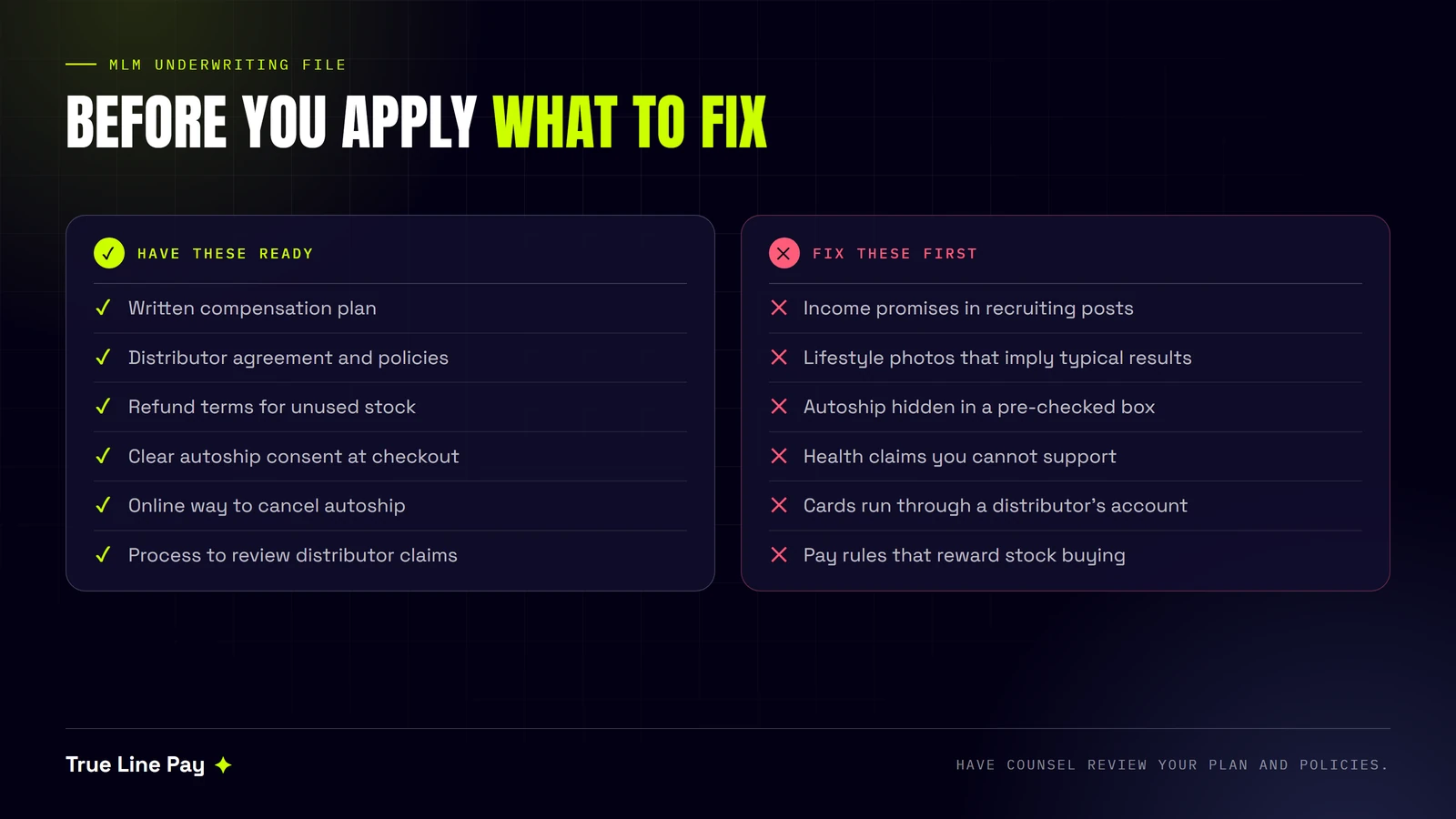
These extras do the most work in an MLM file. Keep them in one folder and keep them current:
- Compensation plan. Show how people earn, and what share of pay ties to sales to real customers.
- Distributor agreement and policies. Include your rules on income claims and health claims.
- Income disclosure. If you publish one, make sure it matches your real data.
- Refund and buyback terms. Spell out how unused stock, kits and fees are handled.
- Autoship flow. Add screenshots from first click to the cancel page.
- Compliance process. Explain how you find bad claims, warn distributors and remove them.
- Product list. Note any health claims and the support behind them.
- Past processing statements. Add these if you’ve taken cards before.
Say so up front if another processor closed your account. A previous closure doesn’t automatically disqualify you, though approval is never certain.
Keeping Disputes Low After You Go Live
Approval is the start, not the finish. Your monthly numbers decide what happens next.
Know the Numbers Your Processor Watches
Visa’s monitoring program counts fraud reports and disputes on card-not-present sales against settled sales. Since April 1, 2026, the merchant “excessive” line in the US, Canada, the EU and Asia Pacific has been 1.5%, with at least 1,500 fraud reports and disputes in a month.
That count means a smaller company may not hit Visa’s line directly. Your acquirer has its own lines for its whole portfolio, at 0.5% and 0.7%, so it may act on your numbers much sooner. Mastercard runs a separate program with its own limits, and our chargeback ratio guide shows how to run the math.
Habits That Cut Autoship and Recruiting Disputes
Most of these cost little and take a day or two to set up. Start with the first two if you’re short on time:
- Track disputes by enrolling distributor. A spike under one person can point to a bad pitch.
- Send a short reminder before each autoship. It gives people a chance to skip or cancel in place of disputing.
- Put the cancel link in every order email. Don’t make people call or hunt for it.
- Use a clear billing name. Visa’s rules call for the name you use with customers, so match the brand your distributors use.
- Refund fast. Giving the money back yourself beats losing it through a dispute and paying a fee on top.
- Offer a second way to pay. ACH payments can collect one-time and recurring orders straight from a bank account.
Some high-risk businesses also carry a rolling reserve, especially when they’re new to processing. If one applies, it should be clearly stated in your merchant agreement, so plan your commission cash flow around it.
Questions to Ask a Provider Before You Sign
All-in-one payment apps set their own rules on what they support, so read the provider’s current restricted list before you build on one. With any provider, get clear answers to these questions:
- Do you name MLM or direct sales as a supported category?
- Will you review the compensation plan before approval, not after a sales spike?
- How will autoship be set up, and what reports will I see?
- What are the reserve terms, dispute fees and exit terms?
- Is all pricing in writing before I sign?
- Who do I call when something goes wrong?
Be wary of anyone who promises approval before reading your plan, or who suggests describing your business as something else. Full disclosure helps keep an account open once volume grows.
True Line Pay offers a hosted checkout page, payment links, a WordPress plugin, a virtual terminal and a payment CRM under one approval, plus ecommerce processing with recurring billing. Its pricing page lists the charges, and final pricing depends on underwriting.
Key Takeaways
- An MLM merchant account covers retail orders, autoship and distributor sign-ups, and the review goes well beyond a normal store’s.
- Approval is a banking decision. It says nothing about whether a plan is lawful.
- Visa’s dispute rules name business opportunities that suggest income, so distributor claims can become chargebacks.
- Autoship needs clear consent, set dates and a simple way to cancel.
- Keep commissions separate, and plan for disputes that land after commissions are paid.
- Send your plan, agreements, refund terms and compliance process with your application.
Frequently Asked Questions About MLM Payments
Do processors treat MLMs as high-risk?
Many do. Glossaries and underwriters often group MLM with nutra and travel because repeat billing, income claims and refund disputes raise the chance of chargebacks.
Does a merchant account mean my MLM is legal?
No. A processor only decides whether to carry your payment risk. Whether a plan is lawful depends on how it works in practice, so ask an attorney who knows direct sales.
Can I charge autoship orders to stored cards?
Yes, if you get express informed consent to a clear agreement first. Visa’s rules also call for set dates or intervals and a simple way to cancel, and ROSCA sets rules for online sales.
Can distributors take cards under my account?
Ask your processor before you allow it. Sales should run through an account that matches who really made the sale, and Visa bans depositing sales that didn’t come from a deal between the cardholder and that merchant.
Does the FTC have a final rule just for MLMs?
We found no final MLM earnings rule as of October 2026. The FTC proposed one in January 2025, and its staff guidance, the FTC Act and the Business Opportunity Rule can still apply today.
Do I need to offer a buyback?
Rules vary, so ask your attorney. FTC staff say a buyback can help participants, but it does not shield an unlawful pyramid scheme from law enforcement.
Can my merchant account pay commissions?
No, it collects payments. Plan payouts through your bank or a payout provider, and ask a tax advisor what reporting applies to your distributors.
What if a distributor makes an income claim I didn’t approve?
Act fast and keep a record of what you did. FTC staff say the onus is on the MLM to make sure participants comply, and a buyer who relied on the claim may dispute the charge.
Will I need a rolling reserve?
You might. Some high-risk businesses have one, especially when they’re new to processing, and it should be clearly stated in your merchant agreement.
Can I apply if a past processor closed my account?
Yes. A previous closure doesn’t automatically disqualify you, but be open about what happened and what you changed. Approval still depends on underwriting.
Conclusion: Treat Payments as Part of Compliance
A stable MLM merchant account comes down to a few plain habits. Tell the bank exactly how money moves, keep income and health claims honest, and make it easy for people to stop an order.
True Line Pay supports direct sales businesses with recurring orders, distributor sign-ups and commissions-driven sales, and every approval depends on underwriting. Start by getting your plan, your policies and your autoship flow in order, because that work helps with any provider.
This article is general information, not legal advice. MLM rules vary by state and country and change over time, so confirm your plan with an attorney who knows direct sales.
Ready when you are
Get Your MLM Payments Reviewed
Tell True Line Pay how your orders, autoship and distributors work. A specialist will explain what underwriting needs for your business. Approval depends on that review, and final pricing is confirmed in your merchant agreement.

Payments specialists helping high-risk merchants get approved and stay processing.