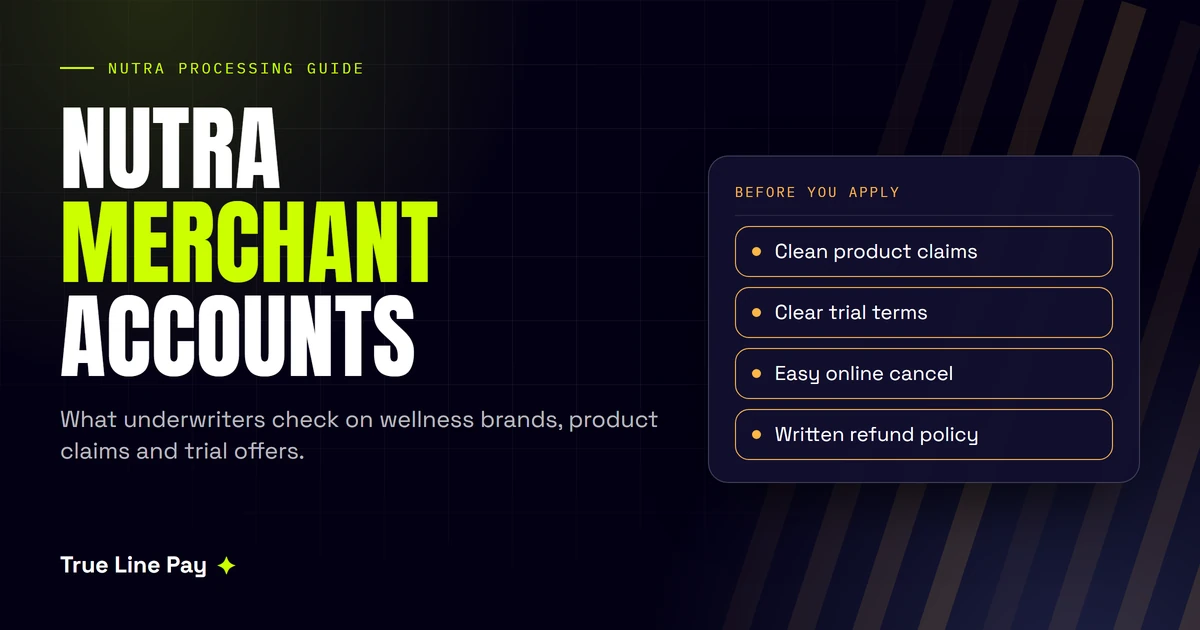
A 30-day trial of a daily greens powder looks like a simple offer. To a bank, that one sale holds three risks: a health-related product, a future charge the buyer may forget, and a sales page that could promise too much. That is why a nutra merchant account gets a closer look than a standard store account.
None of this means wellness brands can’t take cards. It means the bank wants to see how you sell before it lets you sell. Your claims, your trial terms and your cancel button can matter as much as the product in the bottle.
This guide is for nutraceutical and wellness brands that sell online, with or without a subscription. You’ll learn what “nutra” means to a bank, which rules sit behind the review, and how to build an offer that holds up.
You’ll also see where a specialist such as True Line Pay fits in, and what no processor can promise. Rules vary by state and by product, so check your plan with a lawyer before you launch.
What a Nutra Merchant Account Actually Does
A nutra merchant account is a merchant account for nutraceutical and wellness brands, set up by a processor that knows what you sell. It lets you accept credit and debit cards, and repeat charges if approved, after a closer review of your products, claims, policies and billing model.
The money moves the same way it does in any credit card processing setup. What changes is the review before your first sale. For the wider picture, read our guide to the high-risk merchant account.
“Nutra” is a trade word, not a legal class. Federal rules sort a product into groups such as dietary supplement, food or drug. That legal group shapes what you can say about it, so know yours before you apply.
Where Your Product Line Fits
Reviewers don’t treat every wellness product alike. This table shows common groups and the questions they tend to raise, though each processor sets its own policy.
| Product group | What reviewers tend to ask | What to have ready |
|---|---|---|
| Vitamins and minerals | Do the site claims match the label? | Product list and label images |
| Herbal blends | Is each ingredient lawful to sell this way? | Ingredient lists and supplier records |
| Weight or body goals | Do the ads promise results? | The proof behind each claim |
| Beauty and skin blends | Is it sold as a food, a supplement or a cosmetic? | Labels and marketing copy |
| Trial or subscription kits | How does the buyer cancel? | Checkout screens and cancel steps |
Why Payment Apps May Not Fit
All-in-one payment apps are quick to start with, and they set their own rules on what they support. Read the provider’s current restricted list before you load a wellness product. If your product or billing model sits near a limit, it makes sense to apply with a provider that reviews nutra up front.
Why Trial Offers Raise the Stakes
A one-time sale ends at delivery. A subscription keeps going, so each renewal is a fresh chance for a dispute. A trial adds a charge the buyer has to remember, often weeks after the first order.
Banks care because they can be left with the loss if a merchant can’t cover its refunds and chargebacks. So the trial itself isn’t the problem. The problem is a trial that buyers don’t understand.
How a Forgotten Charge Becomes a Dispute
This is a made-up example, but the pattern is easy to picture. Each step is a point where a better process could stop the dispute.
- A buyer pays a small fee for a 30-day trial.
- No one reminds them that the trial is about to end.
- A full-price charge lands under a name they don’t know.
- They look for a cancel link and can’t find one.
- They call their bank instead of you.
The Numbers Banks Watch
Say you settle 2,000 online card sales in a month, and 30 of them draw a fraud report or a dispute. That is a 1.5% ratio, and it is the kind of math a risk team runs every month. A trial that confuses buyers can push that number up fast.
Visa’s VAMP program adds fraud reports and disputes, then divides by settled card-not-present sales. Its “excessive” line for merchants dropped to 1.5% on April 1, 2026, in the US, Canada, Europe and Asia Pacific, once a merchant reaches 1,500 fraud reports and disputes in a month. Mastercard’s Excessive Chargeback Program is widely reported to start at a 1.5% ratio and 100 chargebacks in a month, so ask your processor for the current figures.
A small store may never reach those counts. Your processor still answers for its whole book, though, and Visa grades acquirers at lower ratios than it uses for merchants. So expect questions long before a network program applies.
The Rules Behind Every Nutra Review
An underwriter isn’t a regulator, but they read your store with regulators in mind. Four sets of rules shape that reading.
FDA: What Your Label Can Say
FDA does not approve dietary supplements before they go on sale. The company carries the first duty to keep them safe, and it must be able to back up its claims.
FDA draws a line between two kinds of statement. A structure/function claim describes how a nutrient supports the body’s normal structure or function. A disease claim speaks of treating or preventing a disease, and FDA says only a drug can legally make that claim.
If your supplement label uses a structure/function claim, a few duties follow. Treat this as a starting list for your lawyer, not a full one.
- Hold evidence that the claim is truthful and not misleading.
- Notify FDA of the claim no later than 30 days after you start marketing.
- Print FDA’s required disclaimer on the label.
- Link that disclaimer to each claim. FDA’s December 2025 letter eased the rule on repeating it on every panel, but not this one.
FTC: What Your Ads Can Say
The FTC’s Health Products Compliance Guidance came out in December 2022. It says claims about health benefits need “competent and reliable scientific evidence.” It also reaches past the label to packaging, social media and influencer posts.
Two points are easy to miss. The FTC says the FDA disclaimer won’t cure a deceptive ad, and it says people who help run the marketing can be liable too. Its rule on reviews and testimonials also bans fake reviews.
Subscription Law: ROSCA and the States
The Restore Online Shoppers’ Confidence Act (ROSCA) covers online sales with a negative option. That is a deal where doing nothing counts as saying yes to more charges. It sets three duties on the seller.
- Clearly disclose all material terms before you collect billing details.
- Get the buyer’s express informed consent before you charge.
- Provide a simple way to stop the charges.
The FTC’s wider “click-to-cancel” rule is not in force. A federal appeals court threw it out in July 2025, and the FTC asked for new public comment in March 2026. As of late October 2026, its rule page lists no new proposed rule, so check again before you launch.
ROSCA still applies, and so do state laws. California’s auto-renewal law, for one, calls for express consent, set notice windows and online cancellation for buyers who signed up online. Other states have their own versions, so ask your lawyer which ones reach your buyers.
Card Network Rules
Visa and Mastercard add their own terms on top of the law. Visa’s subscription policy calls for express consent at sign-up and a copy of the terms. It also calls for a reminder at least seven days before the charge when a trial ends, plus a simple online way to cancel.
Mastercard’s FAQ on its subscription rules covers subscription and negative option billing. It says a link to the terms is not enough, so the terms must appear clearly on the payment page and the buyer must accept them before the order is done. A prompt confirmation with cancel steps comes next.
Visa also requires a marker such as “End Trial” in the merchant name on the first charge after a trial. Ask your processor how that is set up on your account.
How to Build a Trial Offer That Holds Up
A strong offer reads the same way to a buyer, a bank and a regulator. Use this checklist as a first pass on every page in your sales funnel.

Then walk through your offer from the buyer’s side. These seven steps cover the points where trials tend to go wrong.
- Say the full price early. Put the trial length, the first charge, the later price and the billing cycle next to the pay button.
- Ask for a clear yes. Use a plain button or an empty box that names the coming charge.
- Confirm right away. Email the terms and the cancel steps as soon as the order is done.
- Remind before you bill. Send a reminder with a cancel link at least seven days ahead.
- Make leaving easy. Put an online cancel link where buyers can find it, and act on it fast.
- Use a name buyers know. Your billing descriptor should match your brand and give a way to reach you.
- Keep your proof. Save the checkout version, the consent record and each reminder you sent.
Watch What Your Affiliates Say
A clean site won’t help if an affiliate’s video promises a result you can’t prove. The FTC guidance says advertisers can be liable for misleading endorsements. It also says material ties between you and an endorser must be clearly disclosed.
Give affiliates approved copy and check their pages often. Drop any partner who keeps making claims you didn’t approve. Our peptide processing guide shows how claim problems play out in a nearby category.
What to Have Ready When You Apply
With True Line Pay, the path has four steps: consultation, application, underwriting and activation. The application is short, online and free to submit. A specialist reviews your documents and keeps you updated.
Gather these items first. Your specialist will confirm what your category needs, and extra items here are the ones a nutra reviewer is likely to ask about.
- Business registration documents
- Government ID for each owner
- Recent business bank statements
- Your website, with clear refund, shipping and privacy policies
- Past processing statements, if you have them
- A full product list with label images
- Supplier or manufacturer details
- Screenshots of your checkout, confirmation email and cancel steps
A past decline or closure doesn’t automatically rule you out. Tell the full story up front, along with what you changed. You can also see the other high-risk industries on the list.
Costs and Terms to Compare
High-risk processing tends to cost more than standard processing, and the headline rate is only one part of it. True Line Pay lists its charges on its pricing page, and final pricing depends on underwriting. Whoever you compare, use these questions.
| Term | What it means | What to ask |
|---|---|---|
| Processing rate | A percentage plus a flat fee on each sale | Do international cards cost more? |
| Monthly fees | Charges for the platform, reports and support | Is there a monthly minimum? |
| Chargeback fee | A flat fee for each dispute | Do I pay it if I win? |
| Rolling reserve | A share of sales held for a set time | What percent, how long, and when is it released? |
| Contract terms | The length of the deal and how to end it | What does leaving early cost? |
Plan for a Reserve
Some high-risk businesses have a rolling reserve, especially when they are new to processing. Say you process $20,000 a month with a 10% reserve held for 120 days. That holds back $2,000 a month, so about $8,000 sits in reserve once the cycle fills.
Those numbers are only an example, and your terms may differ. If a reserve applies, it should be spelled out in your merchant agreement. Build it into your stock and ad budgets before you scale a trial.
Keeping a Nutra Merchant Account Healthy After Approval
Approval is a starting point. These habits help keep the account open as sales grow, and most of them cost little.
- Track disputes by offer. A store-wide average can hide one bad funnel.
- Refund fast. A refund costs you one sale, while a chargeback adds a fee and a mark on your ratio.
- Warn your processor early. Tell them before a big launch, a new product line or a jump in ad spend.
- Keep the live site in line with your file. New products or new offers should be disclosed, not slipped in.
- Review ad copy on a set schedule. Claims can creep in as teams test new angles.
- Offer a second way to pay. ACH payments give buyers another option, but recurring bank debits need their own written authorization.
Your store setup matters too. Ecommerce payment processing with hosted checkout pages can keep card data off your website. Recurring billing is also available for subscription and repeat-order businesses, subject to underwriting.
Key Takeaways
- A nutra merchant account is a card account from a processor that reviews your products, claims and billing model up front.
- “Nutra” is a trade word. Your product’s legal group decides what you can say about it.
- FDA does not approve supplements before sale, and disease claims belong to drugs.
- ROSCA still applies to online subscriptions, even though the FTC’s 2024 click-to-cancel rule was thrown out.
- Visa and Mastercard have their own trial and subscription rules on top of the law.
- Clear terms, a reminder and an easy cancel path are your best defense against disputes.
Nutra Questions Owners Ask Most
Is a nutra account the same as a supplement account?
They overlap, and processors may use the terms in different ways. “Nutra” often points to wellness brands with subscription offers, while “supplement” often points to stores with wide catalogs. What counts is what you sell and how you bill.
Does FDA have to approve my supplement before I sell it?
No. FDA says it has no authority to approve dietary supplements before they are marketed. You still carry duties on safety, labels and claims, so review them with a qualified lawyer.
Can I offer a free trial?
Often yes, if the processor accepts your model and the terms are clear. You will need to meet ROSCA, state law and card network rules. Expect a reviewer to read your checkout, your reminder and your cancel steps.
Is the FTC’s click-to-cancel rule in effect?
No. A federal appeals court vacated the 2024 amendments in July 2025, and the FTC reopened the topic in March 2026. ROSCA and Section 5 of the FTC Act still apply to subscription sellers.
Can I use an all-in-one payment app for my nutra brand?
It depends on that provider’s rules and your product. These apps set their own limits on what they support. Read the current restricted list before you start selling.
How long does underwriting take?
It depends on your category and how quickly you send documents. Many reviews finish within a few business days once a file is complete. Missing items and site fixes can slow it down.
Will I have to keep a rolling reserve?
Maybe. Some high-risk businesses have one, often when they are new to processing. If one applies, the percentage and hold time should appear in your merchant agreement.
Can I apply after another processor closed my account?
Yes. A past closure doesn’t automatically disqualify you, though approval is not guaranteed. Be open about what happened and show what you changed.
Do influencer posts count as my marketing?
They can. The FTC says advertisers can be liable for misleading endorsements, and material ties to an endorser must be clearly disclosed. Give partners approved copy and check their content.
Conclusion: Sell the Trial You Can Defend
A nutra merchant account rewards brands that sell in plain sight. Clean claims, clear trial terms and an easy way out do more for your approval than any clever funnel. They also protect you after approval, when renewals start to run.
Start with your own sales pages, then gather your file. True Line Pay can walk you through what underwriting will look for, and a lawyer can check the claims and terms that only they should sign off on.
This article is general information, not legal advice or medical advice. It makes no claims about any product. Rules differ by state and change over time, so confirm your plans with a qualified attorney.
Ready when you are
Take Your Nutra Offer to a Specialist
Tell True Line Pay what you sell and how you bill. A specialist will explain what underwriting needs to see, and you can review pricing before you apply. Approval depends on underwriting and is not guaranteed.

Payments specialists helping high-risk merchants get approved and stay processing.
1 comment