Five years is a long time to carry a record written for bankers, not for you. Yet that’s how far a search of the MATCH list reaches back.
When an acquiring bank ends a merchant account for certain reasons, it reports the business and its owners to a Mastercard database. Other acquirers check that database before they sign a new merchant. So a problem with one provider can follow you to the next.
A listing isn’t a lifetime ban, though, and it doesn’t make your next application an automatic no. Bank examiners and Visa both tell acquirers to make their own call. A fair review still takes work on your side.
This guide covers what the list is, how merchants land on it and what each reason code means. You’ll also learn how to check your status, what to do next and which mistakes make things worse. At True Line Pay, a past closure doesn’t automatically disqualify an applicant, though approval is never guaranteed.
The MATCH List in Plain Terms
The MATCH list is a Mastercard database of merchants and owners whose accounts were ended for certain risk reasons. MATCH stands for Member Alert to Control High-risk Merchants. Acquirers check it before signing a new merchant, so a listing can follow a business and its owners to the next application.
Today Mastercard calls the system MATCH Pro, and its developer documents describe it as mandatory for Mastercard acquirers. You may also hear “terminated merchant file”, which is the term in Visa’s rules. The OCC’s merchant processing handbook says Visa USA and American Express use MATCH too, though that text dates from 2014.
How a Listing Works, Step by Step
Here’s the path from a closed account to a record other banks can see. These steps come from Mastercard’s public documents.
- An acquirer decides to end the account. The reason has to fit one of the MATCH Pro reason codes.
- It files a record within 5 days. The record includes merchant and principal owner details plus the reason code.
- The record goes live. Mastercard says other acquirers can see it in real time.
- New applications get checked. Before signing a merchant, an acquirer submits the details of the business and its owners. The search covers records added over the past five years and returns exact or phonetic matches.
- The search can keep running. Mastercard’s use-case page says that if nothing matches at first, MATCH Pro keeps searching for 360 days and emails the acquirer if a match appears.
That last step matters. A clean first check doesn’t mean a past problem can’t surface later, so hiding one is a poor bet.
How Long a Listing Lasts
Mastercard’s public developer pages describe a five-year search window, not a listing term. Industry write-ups describe it as a five-year listing. For your exact date, ask the acquirer that filed the record.
What a Listing Is Not
A few things often get mixed up with MATCH. Keeping them apart will help you plan.
- A decline. MATCH records terminations, so being turned down on an application is a different thing.
- A court finding. The OCC handbook says it’s “not uncommon” for merchants to be listed for technical violations of their agreements, or for chargebacks that caused the processor no loss.
- The final word. The handbook says an inquiring bank should always base its decision on its own investigation. Visa’s rules say terminated merchant data should be used only as an informational tool.
How Merchants Land on the MATCH List
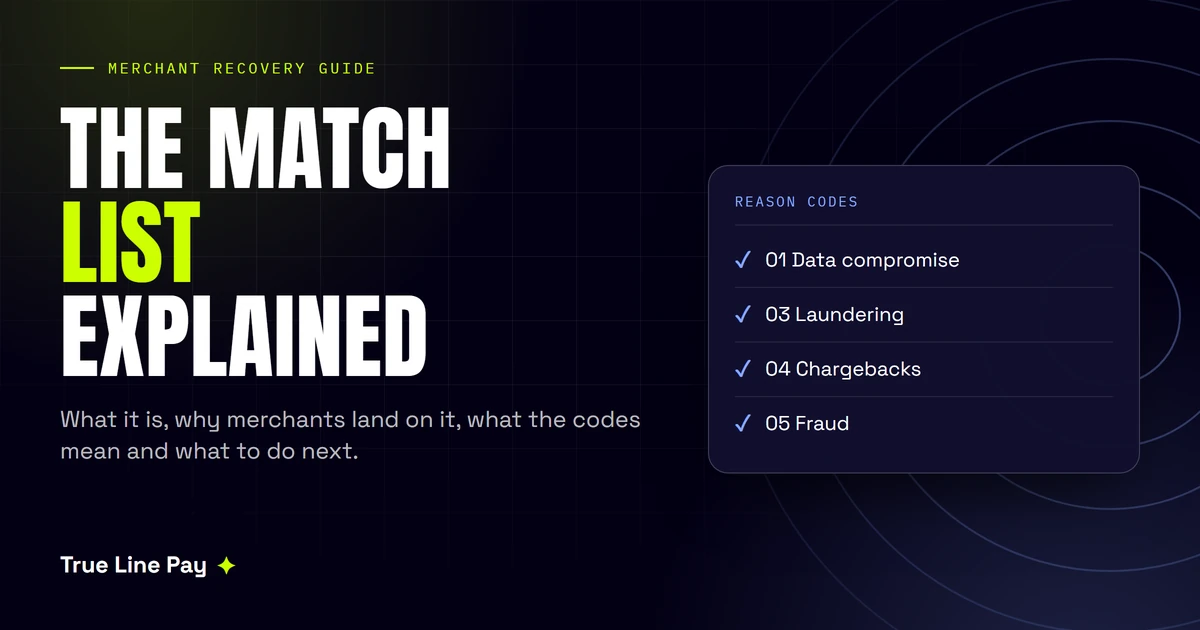
Each record carries a two-digit reason code. Mastercard’s use-case page names the codes below, and the rest sit in its Security Rules and Procedures. The plain-English notes are ours, not Mastercard’s.
| Code | Name in Mastercard’s documents | In plain English |
|---|---|---|
| 01 | Account Data Compromise | Card data was exposed through the business |
| 03 | Transaction Laundering | Another business’s sales ran through the account |
| 04 | Excessive Chargebacks | Too many disputes for the sales volume |
| 05 | Excessive Fraud | Too many fraud reports for the sales volume |
| 11 | Merchant Collusion | The acquirer believes the business worked with others on fraud |
| 12 | PCI Noncompliance | The business didn’t meet card data security standards |
| 13 | Illegal Transactions | Sales that broke the law |
| 14 | Identity Theft | A stolen identity is tied to the account |
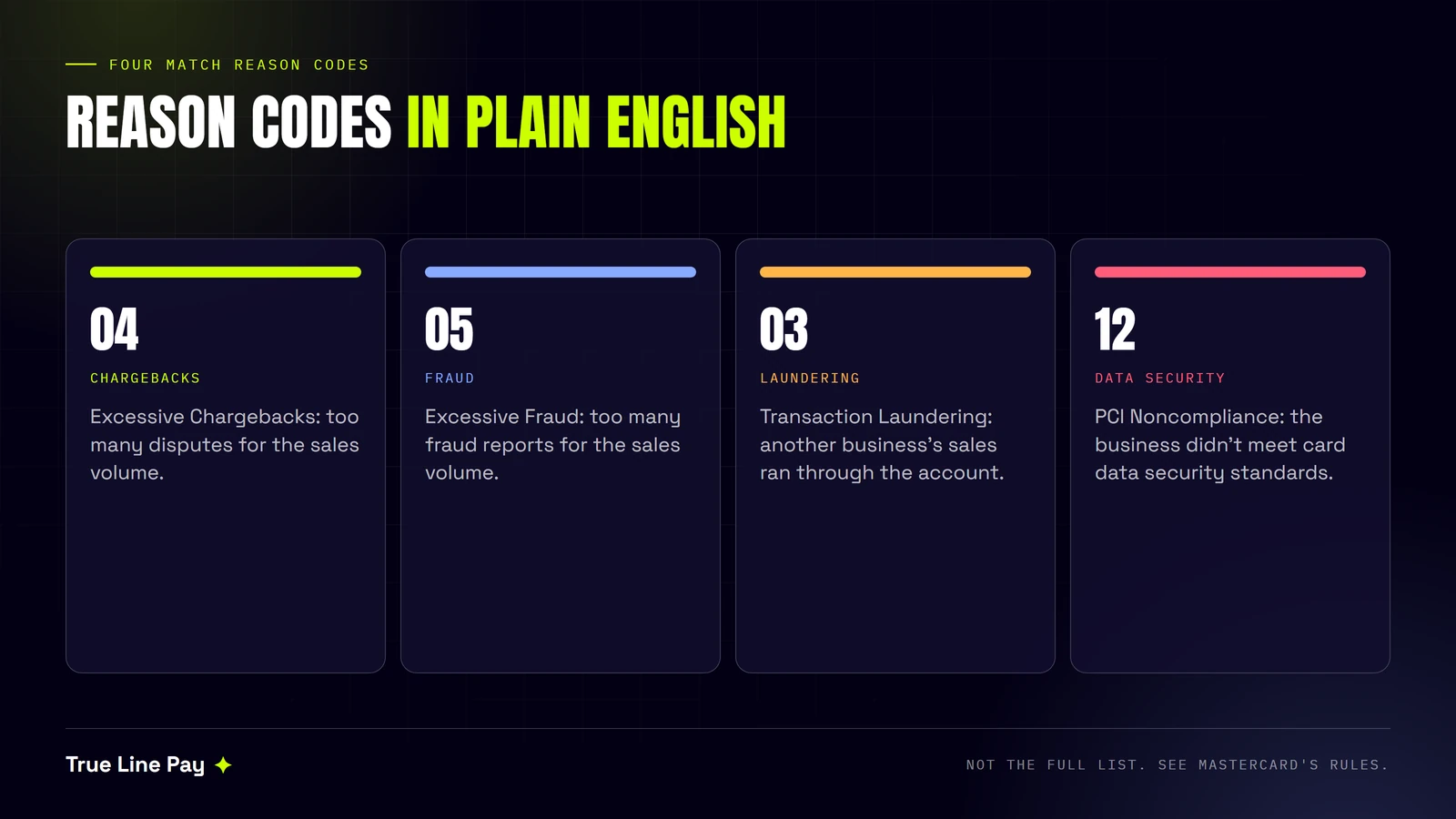
You’ll find exact numeric triggers for codes 04 and 05 quoted online, but those summaries don’t agree with each other, so we won’t repeat one here. Mastercard’s rule text governs. Ask the listing acquirer which test it applied.
The Problems That Can Sit Behind a Code
These are the kinds of business problems that can lead to a listing. They can start small, which is why it pays to act early.
- A promotion or shipping delay sets off a wave of disputes. This guide to your chargeback ratio shows how to track the number.
- A data breach exposes card details, or PCI work never gets finished.
- Fraudsters test stolen cards on your checkout, and fraud reports pile up.
- A partner’s sales get run through your account as a favor.
Visa Runs a Parallel Track
MATCH isn’t the only place a termination gets recorded. The Visa Rules have their own terminated merchant section, and the edition dated October 24, 2026 is the one to read. Here’s how the two line up.
| Point | Mastercard MATCH Pro | Visa terminated merchant rules |
|---|---|---|
| When it’s filed | Within 5 days of the decision to terminate | By close of business the day after you’re told of the intent to terminate |
| Why it’s filed | A listed reason code | Reasons include laundering, a fraud conviction, excessive disputes and Visa program reports |
| How far it reaches | Searches cover the past five years | A 3-year listing on a common terminated merchant database |
| How it’s used | A risk check before signing | Only as an informational tool in the decision |
| Fixing errors | Ask the listing acquirer | The acquirer must request a correction at once after recognizing an error |
Visa adds one more step for a possible match. The acquirer must confirm it’s really the same merchant, then contact the bank that filed the listing to learn why. So expect the story behind your listing to reach any bank that looks closely.
How to Find Out If You’re Listed
Mastercard’s public documents describe access for acquirers, not merchants, so don’t expect to look yourself up. There are still practical ways to find out.
- Read your termination notice. Visa’s rules list written notice of termination among the items in a terminated merchant’s file, so ask for a copy if you can’t find yours.
- Ask your old acquirer in writing. Ask whether it added your business or owners to MATCH or any terminated merchant file, on what date and under which code.
- Find the right party. If you signed through a reseller, the bank behind your account may be a different company. In the US, Visa says the merchant agreement must clearly state the acquirer’s name and location.
- Ask a new provider. If its inquiry returns a match, ask what it can share with you.
What to Do Next If You’re on the MATCH List
Move in this order, and keep copies of everything. The aim is to correct what’s wrong, then prove that what was wrong is fixed.
- Get the facts in writing. Confirm the acquirer, the listing date and the reason code.
- Check that it’s right. Is it your business? Does the code fit what happened? A name mix-up or the wrong code is the simplest problem to fix.
- Ask for a correction if it’s wrong. Send your evidence to the listing acquirer and ask for a written reply.
- Settle what you owe. Clear any fees or chargebacks, or agree on a plan, and keep the proof.
- Fix the cause. Match the fix to the code, such as new refund steps for code 04 or security work for code 12. The PCI Security Standards Council publishes the data security standard.
- Write a one-page account. Cover what happened, when it happened, what you changed and what proof you have.
- Get legal help if you need it. If the listing looks wrong and the acquirer won’t respond, an attorney can review your contract and your options.
Can You Get Removed Early?
It depends on why you were listed and whether the record is correct. Visa’s rules say only the acquirer that added a merchant can request deletion, and it must request a correction once it recognizes an error. Industry summaries of Mastercard’s rules describe a similar route through the listing acquirer, on limited grounds.
So start with the acquirer, not a third party. Be careful with anyone selling a sure-fire removal, because an outside firm can’t simply delete a record.
Moves That Make a Listing Worse
A listing is hard enough on its own. These moves can turn a hurdle into a much bigger problem.
- Opening a new company to hide. Visa’s rules say it may permanently prohibit a merchant or its principals for, among other things, signing a merchant agreement under a new name to get around its rules. MATCH records owners too, so a new name may not help anyway.
- Leaving it off your application. An acquirer’s search may find it, and a false application is a fresh problem of its own.
- Borrowing another merchant’s account. Visa treats this as laundering. The FTC says credit card laundering by telemarketers violates its rule and is a criminal offense under federal law and some state laws.
- Ignoring old debts. The OCC handbook says collectors can seek payment from a business’s principals through negotiation or civil action.
- Waiting without fixing anything. Time alone won’t make a new bank comfortable. Your record of change will.
Applying Again With a Listing
Expect a tougher review. Some acquirers won’t take a listed merchant, and those that do may ask for a reserve, volume limits or higher pricing. Plan your cash around that, and this rolling reserve guide shows the math.
What a Strong File Looks Like
A reviewer needs a reason to believe the old problem won’t return. This guide to merchant account underwriting covers the full file, but a listing calls for a few extras.
- A plain statement of the cause, with the reason code named
- Proof of what changed, such as new refund steps or fraud tools
- Proof that any balance with the old provider is settled
- A complete website and a full product list
- Recent bank statements that show a healthy business
Where to Apply
Look for providers that work with high-risk merchant accounts and will review a listing openly. Tell them up front, before their inquiry does. The True Line Pay industries page shows the categories it supports, and the application is short and free to submit.
You can also ask about ACH payments, which run outside the card networks. A provider will still review your business, and Nacha’s rules set their own limits on returned payments.
Key Takeaways
- The MATCH list is a Mastercard database of merchants and owners terminated for certain risk reasons. Mastercard now calls it MATCH Pro.
- Acquirers file within 5 days of deciding to terminate, and searches cover the past five years.
- Reason codes include 04 for chargebacks, 05 for fraud, 03 for laundering and 12 for PCI.
- Visa has its own terminated merchant rules, and they say the data is only an informational tool.
- Start with the listing acquirer. Under Visa’s rules, only that bank can ask to delete a listing.
- Never hide a listing with a new company or another merchant’s account.
Frequently Asked Questions
What does MATCH stand for?
It stands for Member Alert to Control High-risk Merchants. Mastercard runs the system, and its current documents call it MATCH Pro.
How long does a merchant stay on the MATCH list?
Mastercard’s developer documents say inquiries search records added over the past five years, and industry summaries call that a five-year listing. Ask the acquirer that listed you to confirm your date.
Can I check the MATCH list myself?
Mastercard’s public documents describe access for acquirers, not merchants. Your best routes are your termination notice, a written request to your old acquirer and any new provider that runs an inquiry.
Does being on the MATCH list mean I can’t take cards?
No, but it makes approval harder. The OCC handbook says a bank should base its decision on its own investigation, though some banks will still decline a listed merchant.
Who can remove a MATCH listing?
Start with the acquirer that filed it. Visa’s rules limit deletion requests to the listing acquirer, and industry summaries describe a similar route for Mastercard. An outside firm can’t simply delete a record.
Does MATCH list the owners or just the business?
Both. Mastercard’s documents say a record includes merchant and principal owner details, and the OCC handbook describes MATCH as logging merchants and their owners.
Will a new LLC get around a listing?
Don’t try it. Searches use owner details, and Visa can prohibit a merchant or its principals for signing under a new name to get around its rules.
Can chargebacks alone get me listed?
Yes, Excessive Chargebacks is reason code 04. Watch your ratio monthly, and act long before it reaches your provider’s limit.
Is Visa’s terminated merchant file the same as MATCH?
Not quite. The OCC handbook says Visa USA has used MATCH, but Visa’s rules set their own duties. Those include a 3-year listing period and use of the data as an informational tool only.
Conclusion: A Listing Is a Hurdle, Not the End
The MATCH list can make your next account harder to get, and there’s no use pretending otherwise. Still, it’s a record, not a verdict. Find out exactly what was filed, correct what’s wrong and build proof that the cause is gone.
True Line Pay doesn’t treat a past closure as an automatic no. If you’re ready to explain what happened, talk to a specialist and bring your documents.
This article is general information, not legal advice. Card network rules change and can vary by region, so confirm your situation with your acquirer and an attorney.
Ready when you are
Tell Us What Happened
A past closure doesn’t automatically disqualify you at True Line Pay. Share what happened and what has changed, and a specialist will explain what underwriting needs. Approval isn’t guaranteed.

Payments specialists helping high-risk merchants get approved and stay processing.