Say a family books a safari in January for a trip next October. You charge the card today, pay a supplier deposit next week, and the trip is still nine months away. If the tour falls apart, that charge can come back more than a year after you took it.
That long gap is why a travel merchant account works differently from a store account. A shop ships in days. An agency or tour operator sells a promise, and the bank behind the sale stays exposed until the traveler comes home.
This guide covers what that gap means in practice. You’ll see how long a booking can stay open to disputes, who owes the refund when a flight changes, how Visa treats deposits, and where state seller of travel laws can reach your bank account.
You’ll also get a plain list of what to prepare for underwriting. True Line Pay supports travel agencies, tour operators and booking sites, so these are the topics a specialist would walk through with you. Rules differ by state and country, so use this as a starting point and confirm the details for your business.
Why a Travel Merchant Account Works Differently
A travel merchant account is a card processing account built for businesses that get paid before the trip happens. The bank reviews how far ahead you sell, how you hold customer money and how you handle refunds, then sets terms that fit that gap between payment and travel.
Most sellers deliver close to the sale, so a bank’s risk clears quickly. Travel runs the other way, and the travel payment processing page says it simply: customers pay long before they travel, which raises the risk of cancellations and chargebacks.
Visa’s merchant code manual places travel agencies and tour operators under code 4722, and direct marketing of travel under code 5962. Your processor assigns the code, so describe how you really sell.
Future Delivery in Plain Numbers
Say you take $50,000 a month in bookings, and trips leave about six months after payment. At any moment, roughly $300,000 of trips are paid for but not yet delivered.
That figure is your open exposure. If you failed tomorrow, the bank could face refund claims on all of it, which is why it can matter more to a reviewer than your monthly sales.
How Your Model Changes the Risk
Not every travel business carries the same exposure. How you collect money matters more than what you call yourself.
| Model | What you usually collect | What to plan for |
|---|---|---|
| Agency where suppliers charge the card | Often a service fee only | Refund questions on your fee, and confusion over who charged what |
| Agency as merchant of record | The full trip price | Refund duties and disputes on the full amount |
| Tour operator | Deposits, then balances | Supplier bills due before the trip, plus cancellations |
| Online booking site | Full payment at checkout | Card-not-present fraud and buyers abroad |
How Long a Booking Stays Open to Disputes
For a trip that never happens, the dispute window runs from the trip date, not just the sale date. That one fact changes how you should think about old bookings.
Under the Visa Rules, a “services not received” dispute can be filed up to 120 days after the last date the traveler expected the service, capped at 540 days after processing. For code 4722, the card issuer generally must wait 30 calendar days after the provider cancels, which gives you a window to fix things first.
Take the opening example. A January 15 charge for an October 15 trip is 273 days old at departure, and 120 more days puts the last date about 13 months after the sale.
| Visa dispute condition | Typical travel story | Time limit in short |
|---|---|---|
| 13.1 Services Not Received | Tour is cancelled and no refund follows | 120 days from the expected service date, up to 540 days from processing |
| 13.3 Not as Described | Hotel or tour doesn’t match what was sold | 120 days from processing or from receipt of the service, up to 540 days |
| 13.5 Misrepresentation | Traveler says the terms of sale were misrepresented | 120 days from processing or from receipt of the service, up to 540 days |
| 13.7 Cancelled Services | Traveler cancels, and your policy wasn’t properly disclosed or applied | 120 days from processing or the expected service date, up to 540 days |
Other card networks set their own windows, so ask your processor for those. Federal law runs on a shorter clock: the Fair Credit Billing Act gives cardholders 60 days to dispute billing errors, and the FTC says a delivery date more than 60 days after the statement is likely outside that protection.
That doesn’t end your risk. Card network rules can still apply long after the legal window closes, so plan around the longer clock.
Why One Bad Departure Can Hurt
A cancelled departure can create a burst of disputes in a single month. That matters because monthly ratios are what monitoring programs watch.
Visa’s VAMP program compares fraud reports and disputes with settled sales on card-not-present transactions. The line for a US merchant dropped from 2.2% to 1.5% on April 1, 2026, and it applies once the month’s count reaches 1,500. Your acquirer has its own lines at 0.5% and 0.7% of its whole portfolio, so it may step in well before Visa does.
Our chargeback ratio guide shows how to run these numbers for your own account. Run them before a big group departure, not after.
Who Is the Merchant of Record?
The merchant of record is the business that processes the customer’s payment. The US Department of Transportation defines it for air travel as the carrier or ticket agent “responsible for processing payments by consumers for airfare or ancillary services.”
That label decides who owes the refund. If your agency charged the card for airfare and the airline cancels, the refund duty can land on you, even when the airline still holds the money.
Airfare Refund Deadlines for Ticket Agents
Under 14 CFR 399.80, a ticket agent that is the merchant of record must refund airfare, taxes and ancillary fees on request when a refund is due on a flight to, from or within the US. The deadline is 7 business days after the agent gets the carrier’s information for credit card purchases, and 20 calendar days after the refund becomes due for cash, check, debit and other payments.
DOT rules also tell the carrier to inform the agent without delay and to transfer funds it holds. Those duties help, but your name is still the one on the customer’s card statement.
You can keep a service fee only in limited cases. It must cover more than processing payment for a flight the customer found, it must be charged per passenger, and its amount and non-refundable nature must be clearly disclosed at purchase.
Rule Changes to Watch
DOT is still working on these rules. In July 2026 it extended a pause on enforcing refund rules for some renumbered flights through July 7, 2027, while it works on a rule that would change what counts as a cancellation.
The same notice says standard refund rules remain fully enforceable. Treat the pause as narrow, and check for updates before you change your refund process.
Deposits, Balances and Visa’s Advance Payment Rules
Visa calls any charge for something you’ll provide later an Advance Payment, whether it covers part or all of the cost. Travel agencies sit in Visa’s travel and entertainment group, and that group may take the whole price up front. Recreational services tied to tourism and travel may too.
That permission comes with conditions. Build these into your booking flow, based on the Visa Rules:
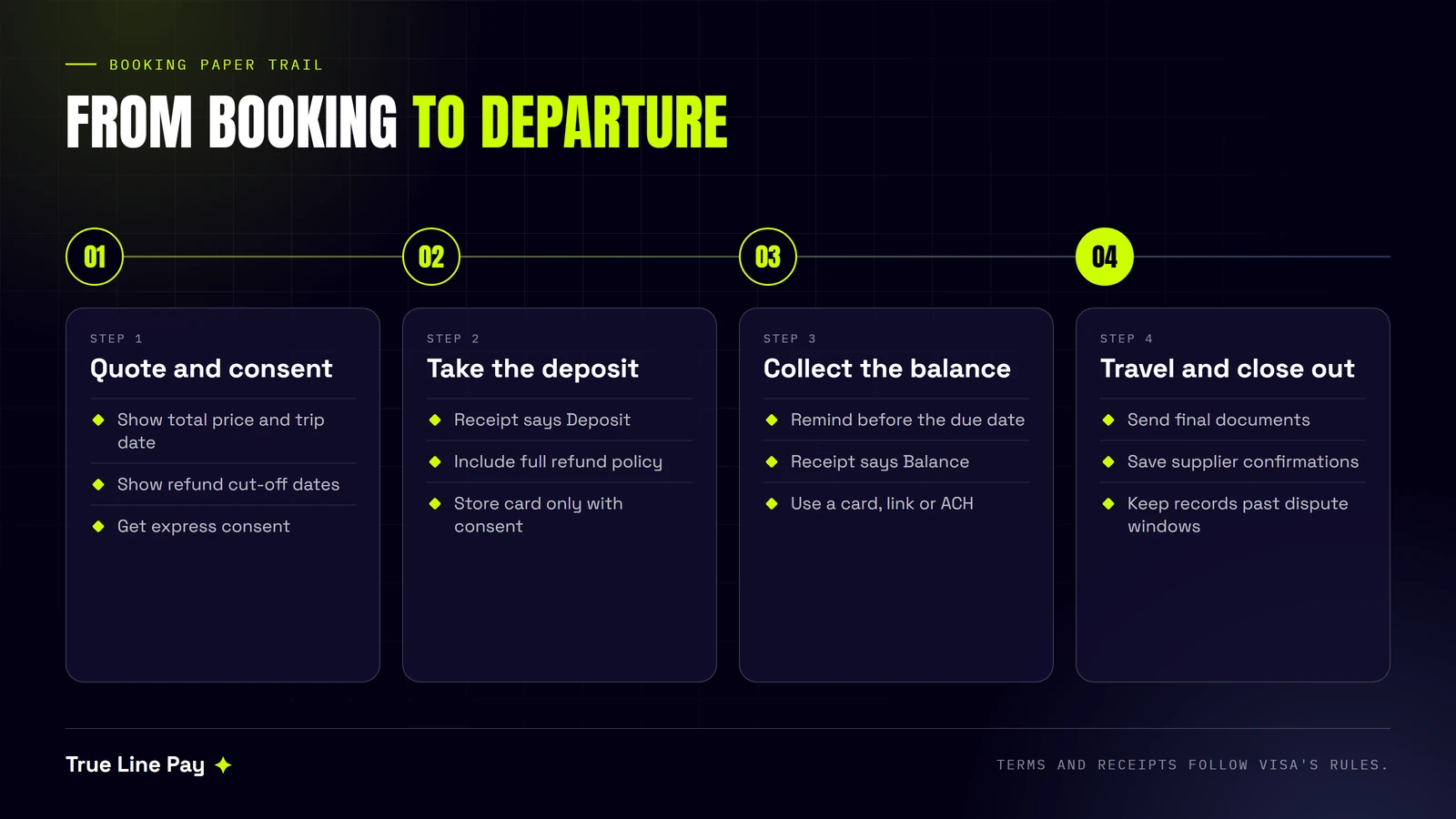
- Get the cardholder’s express informed consent to an agreement before you charge.
- Include the services, the total price and your cancellation and refund terms.
- State the date cancellation rights end without losing the payment.
- Give your location plus an address, email and phone number for contact.
- State when the service will be provided.
- Show these terms on their own, apart from your general terms.
- Refund the full amount paid if you didn’t follow the terms of the sale.
Your receipts have rules too. A deposit receipt needs your full cancellation and refund policy, including the date and time refund rights end, plus the word “Deposit,” “Advance Payment” or “Partial Payment.” The final receipt needs the word “Balance.”
Charging the Balance
You have two clean ways to collect the balance. You can store the card with consent, or send a payment link close to the due date.
If you store the card, the agreement must say how and when you’ll use it. Visa also requires an approval or account check before you store it, and you must not keep the card if that check fails.
Payment Plans for Big Trips
A plan that spreads the cost over several charges counts as a Partial Payment under Visa’s rules when it carries no interest. You can’t add interest, and any late fee must be a flat fee.
Put the schedule in the same agreement as the rest of the booking. A clear schedule helps stop the “I didn’t expect that charge” call.
State Seller of Travel Laws and Your Bank Account
Several states regulate businesses that sell travel. The rules differ on registration, bonds and how client money is held, so check each state where you sell.
| State | Regulator | What to know |
|---|---|---|
| California | Attorney General | Sellers of travel must register, and some must use a trust account or a bond |
| Florida | Department of Agriculture and Consumer Services | Annual registration plus a surety bond, with the amount set by the seller’s type |
| Hawaii | Department of Commerce and Consumer Affairs | Travel agency registration, with client trust account rules under chapter 468L |
| Washington | Department of Licensing | Registration, plus trust rules for sums held more than five business days, with a bond option |
Lists you find online can be out of date. Iowa repealed its travel agency chapter in 2020, for example, yet older guides still show it.
Some of these laws reach beyond your home state. Florida’s program covers nonresident sellers that offer travel services in Florida, so ask your attorney about every state you market to.
Trust Accounts and Your Merchant Account
This is where travel law meets payment processing. Washington’s statute bars a seller from encumbering trust funds and limits withdrawals to items such as paying providers, required refunds and the seller’s commission.
So before you go live, ask where card settlements land and where fees, refunds and chargebacks get debited. If settlements hit a trust account and a processor pulls dispute fees from it, that may not fit your state’s rules, so get your attorney and your processor talking early.
Washington also has an exception for card payments that the carrier or provider processes, when the seller doesn’t deposit the charge into an account it controls. That’s one more reason the merchant of record question matters.
Selling to Travelers Abroad
True Line Pay accepts cards from travelers in 200+ countries, and international cards carry their own rate on the pricing page. Cross-border sales can add both cost and fraud risk, so plan for each one.
These checks fit most agencies and operators. Use the ones that match how you sell:
- Show who and where you are. Visa requires online merchants to show a customer service contact and an address for cardholder correspondence. Your country must appear on the checkout screen or within the checkout pages, and a link to a separate page doesn’t count.
- Match the traveler and the cardholder. A parent may pay for a child’s trip, so send the confirmation to the cardholder too.
- Use 3D Secure online. Under Visa’s rules, a sale that passes Visa Secure authentication can make many card-absent fraud disputes invalid.
- Name your currency. Quote one currency and say which one, since conversion can add fees.
- Check your lodging ads. The FTC’s fees rule covers short-term lodging, including travel agents who advertise it, so the total price has to come first.
Laws outside the US can differ a lot from the rules here. If you market heavily to one country, ask a local advisor what applies there.
Building Your Underwriting File
A strong travel file answers three questions: how far ahead you sell, how much money is open at any time, and who pays whom. Our guide to merchant account underwriting covers the general process, and these are the travel extras.
Have these ready before you apply. Most applications start with the first item, and the rest speak to your booking model:
- Business registration, owner ID, bank statements and website details.
- Seller of travel registration or bond proof, where your states require it.
- A list of suppliers and sample supplier contracts.
- Your average time between payment and departure.
- Your deposit and balance schedule.
- Your cancellation and refund policy, as buyers see it at checkout.
- An explanation of how you hold client funds.
- Past processing statements, if you’ve taken cards before.
If the high-risk merchant account label is new to you, read that guide first. It explains why these questions come up and how the review differs from a standard account.
Tell your processor before a big launch or group sale. A sudden jump in future bookings raises your open exposure fast, so share the plan early.
Handling Cancelled and Changed Trips
A cancelled trip turns into a dispute when the traveler can’t get a clear answer. Fast, written replies do more than any fraud tool here.
Use the same steps every time so nothing slips:
- Reply in writing, and fast. Say what happened and what the traveler can expect.
- Follow your stated policy. If you disclosed it, apply it the same way each time.
- Refund before the bank steps in. Losing a sale hurts less than losing it and paying a dispute fee as well.
- Save your proof. Keep the agreement, the click-to-accept record, itinerary, supplier confirmations and every email.
Visa accepts evidence that you didn’t cancel and the services were available as a response to a future-services dispute. That’s why supplier confirmations belong in the file from day one.
Your terms can’t block a dispute. Visa says a merchant must not require a cardholder to waive the right to dispute a transaction, so drop any “no chargebacks” clause from your booking terms.
True Line Pay’s travel page lists help with documents for disputes on cancelled or changed trips. Check the pricing page for what dispute work costs, since extra support may be charged separately.
Protecting Cash Flow Between Booking and Departure
New travel sellers may see a rolling reserve in their offer, where the bank holds back part of each sale for a set time. Any reserve should appear in writing in your merchant agreement.
Here’s a simple example, not a typical offer. Say your agreement holds 10% of card sales for 180 days, and you process $50,000 a month. After six months, about $30,000 sits in reserve at any time, while your suppliers still expect to be paid on schedule.
Build that into your supplier calendar before you sign. Ask when suppliers need money, then line that up with when your settlements and released reserves arrive.
A second payment option can also help. ACH payments are often more affordable than cards for high-ticket sales, and you can offer them alongside credit card processing for large balances.
Key Takeaways
- A travel merchant account is built around the gap between payment and departure.
- Under Visa’s rules, a services-not-received dispute can come up to 120 days after the expected service date, capped at 540 days from processing.
- The merchant of record owes the airfare refund, so know who charges the card.
- Visa lets travel agencies take full advance payment, but your terms and receipts must meet its rules.
- Seller of travel laws vary, and trust account rules can affect how funds settle.
- Keep proof of every booking, and refund fast when a refund is due.
Travel Payment FAQ
Why is travel considered high-risk?
Customers pay long before they travel, which raises the risk of cancellations and chargebacks. A bank may also be exposed to every trip you’ve sold but not yet delivered.
Can I take a deposit by card?
Yes. Visa treats a deposit as an Advance Payment, so get express consent to your terms first. The receipt should use a word such as “Deposit” and show your full cancellation and refund policy.
How long after a trip can a customer dispute the charge?
For services not received, Visa allows up to 120 days from the last expected service date, capped at 540 days from processing. Other networks set their own limits, so ask your processor.
Do I need a seller of travel registration?
It depends on where you sell. California, Florida, Hawaii and Washington are among the states with their own programs, and some can reach sellers based elsewhere, so ask an attorney to review your states.
Who refunds a cancelled flight I sold?
The merchant of record owes the refund. If that’s your agency, DOT rules give you 7 business days after the carrier’s information on credit card purchases.
Can I keep my service fee if a flight is cancelled?
Only in limited cases. The fee must cover more than processing payment for a flight the customer found, and its amount and non-refundable nature must be clearly disclosed at purchase.
Can I use a no-refund policy?
You can limit refunds if you disclose the policy properly and apply it as written. DOT refund rules and state laws can still override your policy, so have an attorney review it.
Can I take cards from international travelers?
Yes. True Line Pay lists card acceptance from travelers in 200+ countries, and international cards carry their own rate on the pricing page. Final pricing depends on underwriting.
Will I have a rolling reserve?
It’s possible, mainly if you’re new to processing. Any reserve should be stated clearly in your merchant agreement, so read that section before you sign.
Conclusion: Match Your Account to Your Booking Cycle
A travel merchant account works when it matches your real booking cycle. Know your open exposure, know who is merchant of record, and put deposits, balances and refund dates in writing before you charge a card.
True Line Pay sets up accounts for future-delivery bookings, deposits and international customers, subject to underwriting. Get your state registrations and supplier paperwork in order first, and the review should go more smoothly.
This article is general information, not legal advice. Seller of travel laws and DOT rules vary and change, so confirm what applies to your business with an attorney.
Ready when you are
Talk Through Your Booking Model
Share your booking window, deposits and volumes with True Line Pay. A specialist will explain what underwriting needs for a travel business. Approval and final pricing depend on that review.

Payments specialists helping high-risk merchants get approved and stay processing.