FDA’s BeSafeRx page, citing the National Association of Boards of Pharmacy, says only about 5% of the online pharmacies it counted followed US pharmacy laws and practice standards. That page dates from 2020, but the worry behind it hasn’t gone away. It explains why online pharmacy payment processing starts from doubt, even when your license is spotless.
A bank can’t tell a licensed pharmacy from a rogue one by looking at a card sale. So the card networks built extra gates for this trade. Those gates include special merchant codes, sign-up steps and outside reviews.
This guide is for licensed pharmacies and prescription services that sell online. You’ll learn which credentials matter, how Visa and Mastercard treat pharmacy sales, and what the law says about your website and checkout.
You’ll also learn what to prepare before you speak with True Line Pay or any other provider. This is a regulated field and rules vary by state, so work with a healthcare attorney before you change how you sell.
What Online Pharmacy Payment Processing Involves
Online pharmacy payment processing lets a licensed pharmacy take cards over the internet for prescription or related products. It usually adds steps a normal store never sees, such as card network sign-up, proof of state licenses, and in many cases a review by a recognized outside body.
The sale itself looks like any other ecommerce payment processing flow. The buyer pays, the card issuer approves, and the funds settle to your bank. The difference is what has to be true before that first sale goes through.
Who This Covers
The word “pharmacy” covers several business models, and each one raises different questions. Tell your provider which of these describes you.
- Retail pharmacies with a website. You fill prescriptions in a store and now take orders online.
- Mail-order pharmacies. You ship to patients, often across state lines.
- Prescription services. You link patients, prescribers and a partner pharmacy.
- Over-the-counter sellers. You sell items that need no prescription, which may fall under different rules.
- Telehealth brands. You prescribe online and send orders to a pharmacy.
New to this kind of account? Our high-risk merchant account guide covers the basics first.
Why Card Networks Treat Pharmacies Differently
Card networks don’t want their names tied to fake or illegal drugs. So they keep a close watch on pharmacy sales where no card is present. That watch shows up in two places: the code on your account and the sign-up behind it.
Visa: High-Integrity Risk Codes
A merchant category code tells the network what kind of business you run. Visa’s Merchant Data Standards Manual lists card-absent sales under two codes as high-integrity risk. Those are 5122 for drugs and druggist sundries, and 5912 for drug stores and pharmacies.
The Visa Rules put duties on the acquirer, the bank side of your account, before it can process for such a merchant. One of those duties is to register the merchant with Visa. Visa material says this step doesn’t apply to merchants under those codes that are accredited by the National Association of Boards of Pharmacy (NABP).
A 2023 Visa program document also named LegitScript’s certification. Rules like this can change, so ask your processor what applies today.
Mastercard: Registration Program
Mastercard’s Security Rules include a merchant registration program. Editions of those rules have told acquirers to register and monitor pharmacy merchants that sell without a card present. Your processor handles that filing, but it will need your documents to do it.
A Side-by-Side View
This table sums up what to raise with a processor. Card rules change, so treat it as a starting point and not a rulebook.
| Topic | Visa | Mastercard |
|---|---|---|
| Who is flagged | Card-absent sales under codes 5122 and 5912 | Pharmacy sales with no card present |
| Program | High-integrity risk registration | Mastercard Registration Program |
| Who files | Your acquirer or processor | Your acquirer or processor |
| Credentials | NABP accreditation can remove the sign-up step | Ask your processor what it needs |
| Your job | Give licenses and true business details | Give licenses and true business details |
Never Bend the Code
The code on your account has to match what you do. Visa can charge acquirers for failing to register a merchant that should be registered. That cost, and a closure, can land on you.
So don’t ask anyone to code you as a health store. Don’t run prescription sales through another merchant’s account either, and walk away from any provider who offers this. Our guide to the MATCH list shows what a closure for cause can do to your future options.
The Credentials That Open the Door
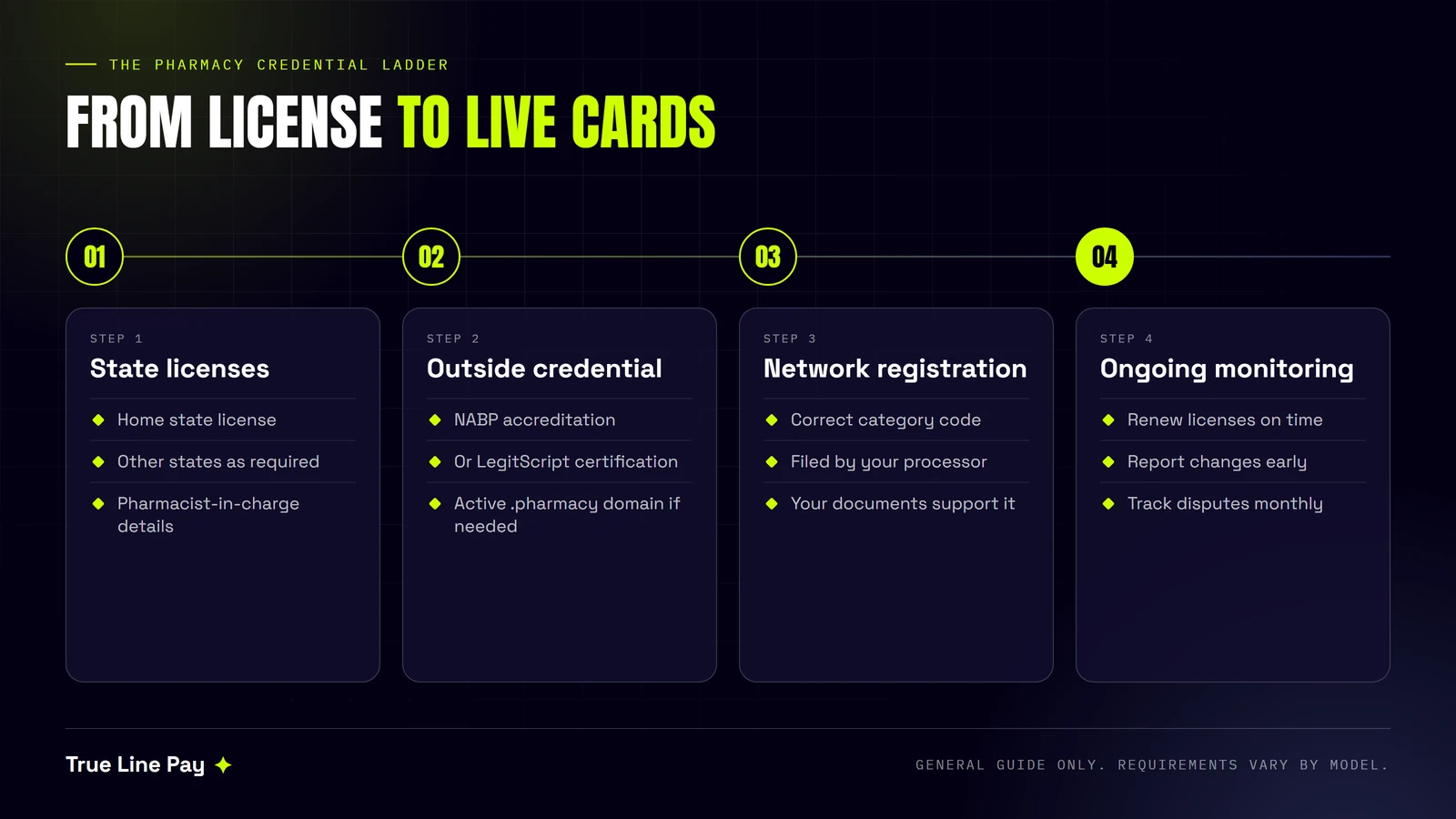
Think of your credentials as a ladder. Each rung depends on the one below it, and a reviewer will start at the bottom.
State Licenses Come First
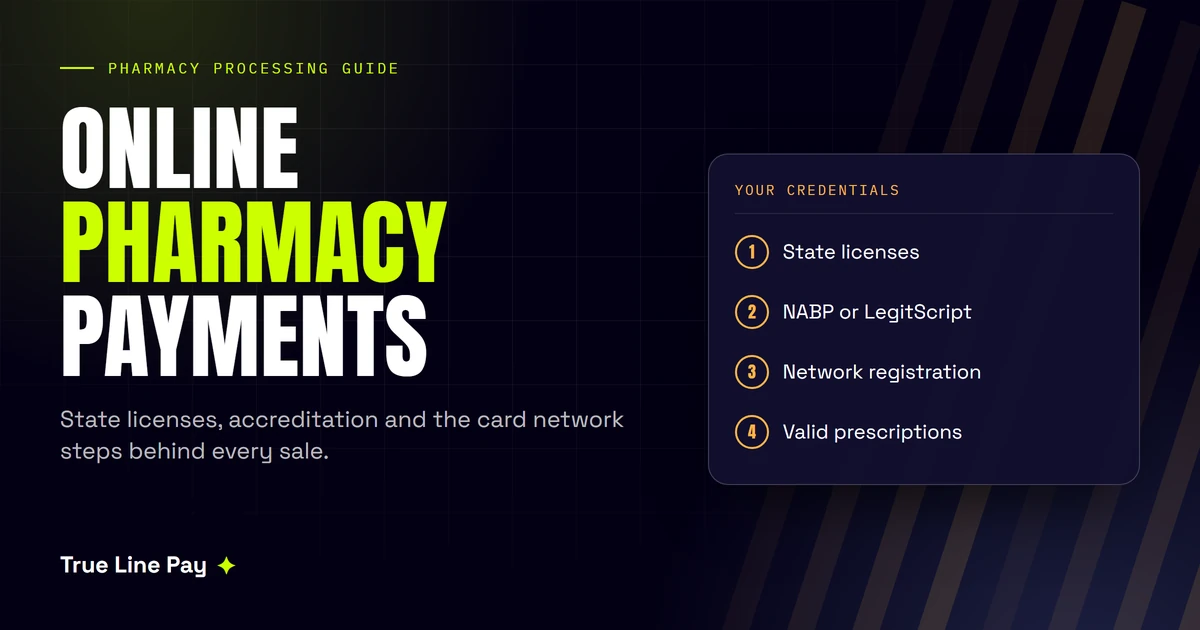
FDA tells consumers to check that an online pharmacy is licensed by a state board of pharmacy. A processor will want the same proof. State rules vary, so a pharmacy that ships across state lines may need a license in each state it serves.
DEA Rules for Controlled Substances
Controlled substances add a federal layer. Under 21 USC 831, an online pharmacy that sells them must meet state license laws wherever it delivers from or to. It must also post set details on its homepage and notify the Attorney General and state boards at least 30 days before it starts.
NABP Accreditation and the .pharmacy Domain
NABP runs Digital Pharmacy Accreditation, once known as VIPPS. To apply, you first need Healthcare Merchant Accreditation and an active .pharmacy domain. The program includes a policy review and an on-site survey.
It runs for a three-year term, with reviews in the years between. NABP lists other terms too, such as an active license in every place you do business. Check the current list before you budget for it.
LegitScript Certification
LegitScript runs a separate Healthcare Merchant Certification. The company says Visa and Mastercard recognize it for pharmacies and telemedicine providers. Your processor can tell you whether it would accept this, NABP or both for your model.
Credentials at a Glance
Here is the same ladder as a quick table. Your own list depends on your model and your states.
| Credential | Who it’s for | Why a processor asks |
|---|---|---|
| State pharmacy license | Any pharmacy, in each state that requires one | Shows you can lawfully dispense |
| DEA details | Pharmacies that handle controlled substances | Shows you meet federal rules |
| Healthcare Merchant Accreditation | Health sites, and a first step for Digital Pharmacy | Shows ongoing outside review |
| Digital Pharmacy Accreditation | Licensed pharmacies with online services | A strong outside check on your practice |
| LegitScript certification | Pharmacies and telemedicine providers | Visa and Mastercard recognize it, the company says |
Prescription Rules That Shape Your Checkout
Your checkout has to reflect the law, not just your cart software. A processor may test the flow as a buyer would, so make sure it can’t be gamed.
A Valid Prescription Comes First
FDA says a safe online pharmacy requires a prescription from a licensed health professional. It also warns about sites that let buyers skip that step. If a shopper can buy a prescription drug with none on file, expect trouble.
For controlled substances, the Ryan Haight Act goes further. Under 21 USC 829(e), a valid internet prescription generally rests on an in-person medical evaluation, with exceptions that include the practice of telemedicine. Temporary flexibilities on that rule run through December 31, 2026 unless they change, so check the latest status with counsel.
Website Details to Check
FDA publishes simple checks for a safe pharmacy, and they make a good self-test. Start with this list, then add your attorney’s notes.
- A physical US address and phone number.
- A licensed pharmacist who can answer questions.
- A clear rule that prescription items need a valid prescription.
- No sales pitch built on deep discounts or “no prescription needed.”
- Your license details, and the state boards that issued them.
- Clear refund, shipping and privacy policies.
- The DEA and homepage notices that apply to you.
FDA also warns about sites that say medicine will ship from a foreign country. If you source or ship across borders, raise it early with your attorney and your processor.
Health Claims Still Matter
Pharmacies market too, and those pages count. The FTC’s Health Products Compliance Guidance says health claims need “competent and reliable scientific evidence.” Weight-loss pages deserve extra care, since they are often the first thing a reviewer opens.
What a Processor Will Ask For
Good merchant account underwriting for a pharmacy looks past bank statements. Gather these items in one folder before you apply.
- Business registration documents and owner ID.
- Recent business bank statements.
- State pharmacy licenses, with expiry dates.
- The name and license of your pharmacist-in-charge.
- Any NABP accreditation or LegitScript certification.
- DEA details, if they apply.
- Your website, with its policies live.
- A full list of products and how you source them.
- Your prescription check and how it works at checkout.
- Past processing statements, if you have them.
True Line Pay lists online pharmacy among its supported industries, with a focus on licensed online pharmacies and prescription services. A specialist reviews your documents and gives you updates, but approval depends on underwriting. The first step is a consultation, so you can ask what your model needs before you apply.
Questions Worth Asking Any Provider
Not every provider that takes high-risk merchants works with pharmacies. These questions can help you sort out who does.
- Do you board pharmacy merchants today under the right code?
- Who files the network sign-up, and who pays any fee?
- Which credential will you accept for my model?
- Will my sales run under my own merchant ID?
- What happens if a license lapses or I add a state?
Running Payments After Approval
Passing the review is only the start. You are expected to stay in good standing, and these credentials usually come with ongoing checks.
Keep Your File Current
Put license and credential renewals on a shared calendar. Tell your processor before you add a state, a product line or a partner pharmacy. A lapse you hide is much worse than one you report.
Mind Your Dispute Ratio
Prescription orders can draw disputes over delays, refills and mix-ups. Visa’s VAMP program measures fraud reports and disputes against settled card-not-present sales. Its “excessive” line for merchants has been 1.5% since April 2026 in the US, Canada, Europe and Asia Pacific, with a minimum of 1,500 events a month.
Your processor may act well before that. Our guide to your chargeback ratio shows the math, and these habits help keep it low.
- Use a billing descriptor patients will know, and leave drug names out of it.
- Tell patients about delays before they call their bank.
- Explain your refund rules, since state rules may limit what you can take back.
- Keep a record of each prescription check.
Refills and Auto-Ship
Automatic refills are recurring charges. If buyers enroll online, ROSCA calls for clear terms, express consent and a simple way to stop. Card network subscription rules can apply as well, so confirm them with your provider.
Plan for Reserves and Fees
High-risk accounts may carry a rolling reserve, and pharmacies can add credential and sign-up costs. Published charges are on the pricing page, and final pricing depends on underwriting. Budget for the whole cost before you compare rates.
Key Takeaways
- Online pharmacy payment processing adds network sign-up and credential checks to a normal online sale.
- Visa lists card-absent sales under codes 5122 and 5912 as high-integrity risk.
- Mastercard’s rules cover pharmacy merchants that sell without a card present.
- Start with state licenses, then look at NABP accreditation or LegitScript certification.
- Controlled substances bring extra federal rules, and the telemedicine flexibilities have an end date.
- Never hide your business behind another code or another merchant’s account.
Pharmacy Payment Questions and Answers
Does an online pharmacy need a special merchant account?
Most need an account from a provider that boards pharmacy merchants under the right code. Card-absent pharmacy sales carry extra network rules. A standard account may not cover them.
Is NABP accreditation required to take cards?
Not in every case, and it depends on your model and your processor. Visa material says NABP accreditation can remove the sign-up step for high-integrity risk merchants. Ask your provider what it needs.
What is the difference between NABP and LegitScript?
NABP is the association of state pharmacy boards, and it runs accreditation programs. LegitScript is a private company that runs a health merchant certification. Your processor can confirm which one it accepts.
What merchant category code will I use?
Pharmacy merchants commonly fall under 5912 or 5122, and your acquirer assigns the code. It must match what you really do. Don’t ask anyone to use a code that hides your business.
Can I use an all-in-one payment app?
These apps set their own rules on what they support. Read the provider’s current restricted list for prescription products before you start. Then confirm your plan with your attorney.
Do over-the-counter stores face the same rules?
Not always, but the codes and reviews can overlap. Your product list and business model decide how you are treated. Tell the processor exactly what you sell.
Can I ship prescription drugs to any state?
Only where you are licensed or otherwise allowed. State rules differ, and a pharmacy that delivers controlled substances must meet the license laws of each state involved. Check with your attorney and each state board.
How long does approval take?
It depends on your credentials and how fast you send documents. Accreditation runs on its own timeline, so plan for it early. Your specialist can tell you where your file stands.
Can a telehealth company use a pharmacy’s account?
Don’t run sales through another business’s account. Each business needs an account for what it sells, and using someone else’s can break card rules. Ask your processor how to set up a shared model.
Conclusion: Credentials First, Then Cards
Online pharmacy payment processing rewards order. Get the licenses right, choose your outside credential, and build a checkout that proves a prescription is on file. After that, the card network steps become paperwork, not a wall.
When your file is ready, True Line Pay can review your model and explain what underwriting needs. Keep your attorney involved, since these rules can shift quickly.
This article is general information, not legal advice or medical advice. Pharmacy laws differ by state and change often, so confirm your plans with a qualified healthcare attorney and your state board of pharmacy.
Ready when you are
Bring Your Pharmacy File to a Specialist
True Line Pay can review your licenses, your website and your business model, then explain what underwriting needs. You can see published pricing before you apply. Approval depends on underwriting and is not guaranteed.

Payments specialists helping high-risk merchants get approved and stay processing.