Run one month of sales through Visa’s formula, then through Mastercard’s, and you can get two different answers. That surprises a lot of owners, who assume a chargeback ratio is one fixed number.
It isn’t. Each card network counts its own activity, uses its own formula and sets its own minimum count. Your merchant agreement may add a limit of its own on top.
For a high-risk business, this number can shape your whole payment setup. A rising ratio can lead to extra reviews, a larger reserve, assessments passed down from your bank, or a closed account. It’s far better to learn the math before a warning letter arrives.
This guide shows you how to work out the number by hand, with examples you can copy. You’ll see what Visa and Mastercard each measure, where their published limits sit, and why a small store can have a problem long before it reaches either one. Then we’ll walk through practical ways to bring it down, and the questions True Line Pay suggests you put to your processor.
Chargeback Ratio Meaning in Plain English
A chargeback ratio is the number of chargebacks on your merchant account in a set period, divided by the number of card transactions in a set period, shown as a percent. Banks, card networks and underwriters use it to judge how often buyers reverse payments through their card issuer.
A chargeback is a payment reversed by the buyer’s bank after the buyer disputes the charge. Our payments glossary explains this and related terms in plain English.
Underwriters often check this number when they review a high-risk merchant account. Acquirers keep watching it after you go live, so it matters for as long as you take cards.
It Counts Events, Not Dollars
Visa and Mastercard both build their ratios from counts, not dollar amounts. A $15 dispute moves your ratio just as much as a $1,500 dispute.
That cuts both ways. A cheap item can hurt your ratio as much as an expensive one, even though the money at stake is small. So a low-ticket store can’t shrug off small disputes.
How to Calculate a Chargeback Ratio
You need two numbers from your processor reports and a calculator. Use counts, and keep Visa and Mastercard apart if your reports allow it.
- Pick a month. Use one full calendar month, not a rolling 30 days.
- Count the chargebacks. Count every chargeback you received in that month, no matter when the sale took place.
- Count the sales. Use the number of sales transactions for the period your formula calls for.
- Divide, then multiply by 100. The result is your ratio as a percent.
Here’s an example. Say you received 60 Mastercard chargebacks in October, and you had 5,000 Mastercard sales in September. That’s 60 ÷ 5,000 = 0.012, or 1.2%.
Network papers often use basis points instead of percents. One percent equals 100 basis points, so 1.2% is 120 basis points and 1.5% is 150.
Why a Slow Month Can Push Your Ratio Up
Chargebacks can arrive weeks or months after the sale, so they often land in a quieter month than the one that caused them. Acquirer guides describe Mastercard’s formula as this month’s chargebacks divided by last month’s sales. That creates a trap for seasonal stores.
Say your sales fall from 9,000 in September to 4,000 in October, and you receive 70 chargebacks in both October and November. October’s ratio is 70 ÷ 9,000, or 0.78%. November’s ratio is 70 ÷ 4,000, or 1.75%.
Nothing got worse in that example except your sales volume. Plan for this before a quiet stretch, and warn your processor if a big promotion is about to end.
What Visa and Mastercard Actually Measure
Both networks run programs that watch for problem merchants. They don’t count the same things, though, so check each one on its own.
Visa: The VAMP Ratio
Visa’s program is the Visa Acquirer Monitoring Program, or VAMP. Its core number is a single count-based ratio that adds fraud reports to disputes, then divides by settled transactions. It covers card-not-present sales only, both domestic and cross-border.
Fraud reports come from card issuers. The Visa Rules say an issuer must report the fraud to Visa before it files a card-absent fraud dispute, so one stolen-card order can show up as both a fraud report and a dispute.
Visa’s formula adds the two counts together, and several industry sources read that as a double count on the same sale. The fact sheet doesn’t address the point directly, so ask your processor how your number is built.
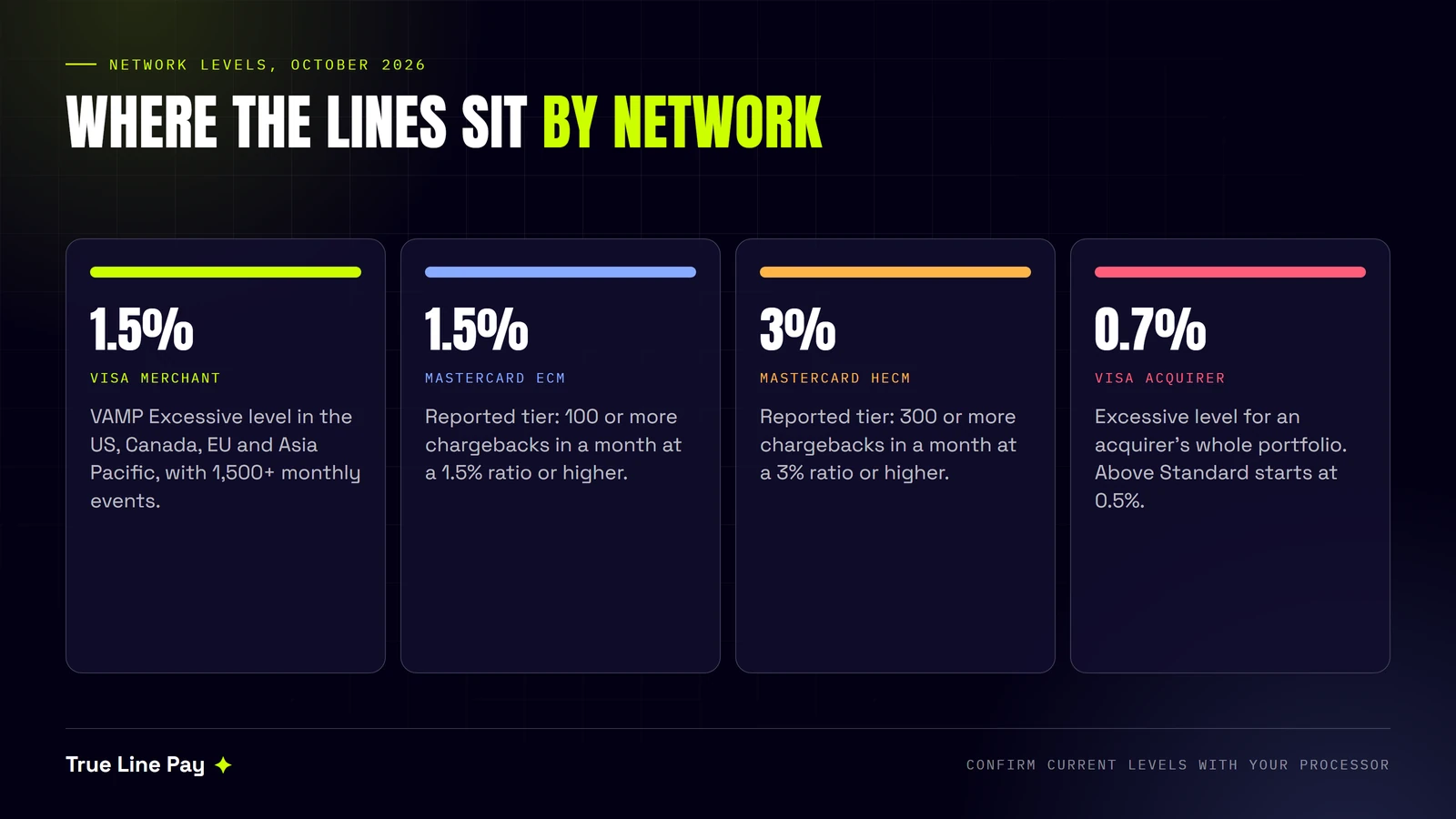
Visa’s fact sheet puts the merchant Excessive level at 1.5% in the US, Canada, the EU and Asia Pacific from 1 April 2026, down from 2.2%. A merchant also needs at least 1,500 fraud reports and disputes in the month. Other regions differ, and Visa says programs for Brazil, Chile and India will come later.
Visa leaves two things out of the count, subject to data timing. One is disputes resolved through pre-dispute tools, and the other is fraud reports that qualify under Compelling Evidence 3.0.
Mastercard: The Excessive Chargeback Program
Mastercard’s Security Rules and Procedures set out this program in Section 8.3. The figures here come from an acquirer’s published merchant guide dated 2019, so ask your processor to confirm the current numbers. Confirm the current numbers with your processor.
That guide lists two tiers. An Excessive Chargeback Merchant (ECM) has at least 100 chargebacks in a calendar month and a ratio of 1.5% or more. A High Excessive Chargeback Merchant (HECM) has at least 300 chargebacks and a ratio of 3% or more.
The ratio is chargebacks received in a calendar month, divided by sales transactions in the month before. The same guide says fines start in the second month in a row over the line, and a merchant must stay under the limit for three months in a row to leave.
Industry reports say Mastercard plans to rework these programs from April 2027, with tighter levels later on. Treat that as unconfirmed, and ask your processor what will apply to your account.
Visa and Mastercard Side by Side
| Question | Visa VAMP | Mastercard program |
|---|---|---|
| What goes on top? | Fraud reports plus disputes | Chargebacks received in the month |
| What goes on the bottom? | Settled transactions | Sales transactions from the month before |
| Which sales count? | Card-not-present only | Not limited to online sales, per a 2019 acquirer guide |
| Merchant level | 1.5% in the US, Canada, EU and Asia Pacific | 1.5% for ECM, 3% for HECM |
| Minimum monthly count | 1,500 fraud reports plus disputes | 100 chargebacks for ECM, 300 for HECM |
| Source for this table | Visa fact sheet | Acquirer merchant guide, 2019 |
One Store, Two Numbers
Say a store had 40,000 settled online Visa sales, 420 disputes and 300 fraud reports in a month. Its Visa ratio is 720 ÷ 40,000, or 1.8%. That’s above 1.5%, but 720 events is under the 1,500 minimum, so it wouldn’t meet Visa’s merchant level.
Now say the same store had 8,000 Mastercard sales last month and 90 Mastercard chargebacks this month. Its Mastercard ratio is 90 ÷ 8,000, or about 1.13%. It’s under both the ratio and the count, yet its processor may still want a talk.
Why the Minimum Counts Don’t Make You Safe
Minimum counts keep many small stores out of network programs. At a 1.5% ratio, you’d need about 100,000 Visa card-not-present transactions a month to reach 1,500 events. On Mastercard, you’d reach 100 chargebacks at 1.5% with about 6,700 sales.
That doesn’t mean a small store can ignore the number. Visa’s fact sheet flags an acquirer’s whole portfolio at just 0.5%, which it calls Above Standard, and at 0.7%, which it calls Excessive. A bank that answers for its portfolio has good reason to act on a merchant well under the 1.5% mark.
Your merchant agreement may also set its own limit. Find that number, and write it next to your monthly figures.
What a High Ratio Can Cost You
The cost goes well past the refunded sale. Here’s what can follow, depending on your agreement and your bank:
- Lost sale and goods. The money goes back, and you may not get the product back.
- Dispute fees. Many processors charge for each chargeback. True Line Pay lists its dispute charges on its pricing page.
- Network action. Visa says entities over a threshold must put risk controls in place, and it may require an acquirer or merchant to deploy remediation tools.
- Disputes you can’t easily answer. Issuers can file under Visa’s Condition 10.5 for transactions a monitoring program identifies, and response rights there are limited.
- Assessments passed down. A network charge on your acquirer may land on you, depending on your agreement.
- A reserve or closure. Your acquirer may hold back funds, cap your volume or end the account under your agreement.
Don’t Try to Game the Number
Some owners are tempted to change a business name or split sales across accounts to reset the count. The Visa Rules deal with this directly. If Visa finds a merchant name, merchant data or merchant performance was altered to get around VAMP, it can charge the acquirer $25,000 per merchant per month, permanently bar the merchant and its principals, or both.
Small test charges made to pad your sales count could fall under the same rule. Lower the top of the formula instead of inflating the bottom.
How to Lower Your Chargeback Ratio
Start with your data, not with new tools. Visa’s dispute guide sorts disputes into four groups, and each one needs a different fix.
| Dispute group | What it often means | Where to start |
|---|---|---|
| Fraud | The cardholder says they didn’t take part in the sale | Address checks, CVV2 and 3D Secure on online orders |
| Authorization | The sale wasn’t properly authorized | Review your authorization setup with your processor |
| Processing errors | Wrong amount, duplicate charge or wrong currency | Check your checkout, batching and gateway settings |
| Consumer disputes | Not received, not as described, credit not processed or cancelled recurring charge | Delivery updates, refunds, clearer pages and easy cancellation |
Step 1: Pull 90 Days of Reasons
Ask your processor for a list of chargebacks with their reason codes. Group them by product, by traffic source and by reason. One bad product line or one misleading ad can drive most of a problem.
Step 2: Make the Charge Easy to Recognize
Visa names customers not recognizing the business name on a statement as a preventable cause of disputes. Bill under the name buyers saw at checkout, and repeat that name on receipts and order emails.
Step 3: Refund Fast and Reply Faster
Visa’s guide says to respond quickly when a customer reaches out, and to issue a legitimate refund as soon as possible. A refund costs you one sale. A chargeback can cost the sale, a fee and a mark on your ratio.
Step 4: Screen Online Orders
Visa points card-absent merchants to address checks, CVV2 and Visa Secure. Our ecommerce payment processing includes screening tools that flag risky orders before you ship.
Step 5: Take Extra Care With Subscriptions
Forgotten renewals can drive disputes in categories like nutra. For negative option offers, the Visa Rules call for clear terms at checkout, express consent, and written notice at least 7 days before a charge when a trial or promotional period is ending.
Step 6: Use Pre-Dispute Tools
Visa’s Order Insight shares order details with participating issuers when a cardholder questions a charge. Rapid Dispute Resolution lets you set rules, through your acquirer, to resolve eligible disputes early. Mastercard’s Ethoca services offer a similar early warning.
Be careful with what these tools fix. Visa’s fact sheet leaves out disputes resolved through pre-dispute tools, but the only fraud reports it lists as excluded are those that qualify for Compelling Evidence 3.0. A refund may remove the dispute and still leave the fraud report in your count, so ask your processor.
Step 7: Track It Every Week
Monthly reports show you the damage after it’s done. A short weekly check lets you act sooner:
- Chargebacks received this week, by network and reason
- Fraud reports, if your processor shows them
- Sales count for the current and previous month
- Refunds issued, and how long they took
- Your own limit, taken from your merchant agreement
Key Takeaways
- A chargeback ratio isn’t one number. Visa and Mastercard use different formulas and minimum counts.
- Visa’s VAMP ratio adds fraud reports to disputes and covers card-not-present sales only.
- Acquirer guides describe Mastercard’s ratio as this month’s chargebacks divided by last month’s sales.
- Falling sales can raise your ratio even when chargebacks stay flat.
- Visa’s published merchant level is 1.5%, but Visa flags acquirer portfolios at 0.5% and 0.7%.
- Check your merchant agreement, because your own limit may be lower than any network level.
- Sort disputes by reason first, then fix the cause.
Frequently Asked Questions
What is a good chargeback ratio?
We haven’t seen a network publish a “good” number. The published levels are trigger points, not targets, so lower is better. Your practical limit is whatever your merchant agreement and your acquirer set.
How do I calculate my chargeback ratio?
Divide your chargebacks for the month by your sales transactions, then multiply by 100. For Mastercard, acquirer guides use the previous month’s sales. For Visa’s VAMP ratio, add fraud reports to disputes and divide by settled card-not-present transactions.
Is 1% the chargeback limit?
Not in the Visa fact sheet or the acquirer guide we reviewed. You’ll hear 1% quoted often, and some acquirers may set a limit near it in their own terms. Check your agreement instead of relying on a general rule.
Do Visa and Mastercard use the same formula?
No. Visa’s ratio includes fraud reports and covers card-not-present sales only. The Mastercard ratio described by acquirers uses chargebacks and the previous month’s sales.
Do chargebacks I win still count?
They may. Visa’s fact sheet lists only two exclusions, and winning a dispute later isn’t one of them. Ask your processor how won cases appear in your reports.
Does a refund lower my ratio?
A refund before a dispute is filed can stop that dispute from happening. It doesn’t erase a chargeback that already exists. It may not remove a fraud report either, so refund early and check with your processor.
Do in-store sales count toward VAMP?
No. Visa’s fact sheet covers card-not-present transactions only. Mastercard’s ratio, as described in that acquirer guide, isn’t limited to online sales, so a store with both channels should ask its processor.
Can a small store get in trouble with a low count?
Yes. The minimum counts apply to network programs, not to your acquirer’s own risk rules. An acquirer can act under your merchant agreement even if you never reach a network level.
What happens if I go over a network limit?
Visa requires entities over its thresholds to put risk controls in place. Acquirer guides describe Mastercard fines that begin in the second month in a row. Your acquirer may also pass costs on or change your terms, so call them early.
Conclusion: Know Your Number Before Your Bank Calls
Your chargeback ratio is simple math with serious results. Work it out for each network, every month, and compare it with the limit in your own agreement, not just the published levels.
When the number moves, look at the reasons before you buy new tools. Many fixes are plain habits: a name buyers know, quick refunds, honest delivery dates and sensible fraud checks.
True Line Pay builds credit card processing for high-risk businesses, with specialist underwriting and a person who can talk through your file. Bring your numbers to that first conversation, even if they aren’t perfect.
This article is general information, not legal advice. Card network rules and thresholds change, so confirm current figures with your processor and read your merchant agreement.
Ready when you are
Talk Through Your Numbers With a Specialist
True Line Pay works with high-risk businesses that need card processing suited to their category. Talk to a payments specialist about your products, volumes and chargeback history. Approval isn’t guaranteed, and final pricing depends on underwriting.

Payments specialists helping high-risk merchants get approved and stay processing.
2 comments