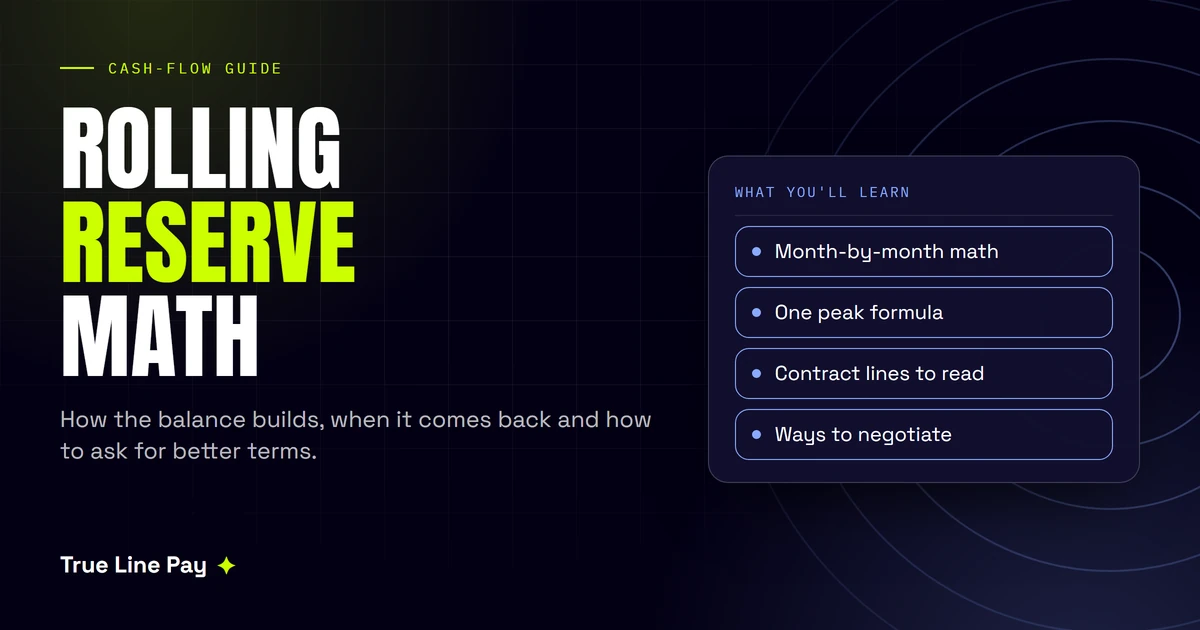
Sell $20,000 this month and you may see only $18,000 of it for now. The other $2,000 isn’t a fee, and it isn’t gone. It’s a rolling reserve, and it can shape your cash flow for months before the first dollar comes back.
The term usually appears in the merchant agreement, and the percentage looks small on the page. The number that really matters isn’t printed there. It’s how much of your cash sits out of reach at the peak, and when it starts to return.
This guide works through that math with plain examples. You’ll see how the balance builds, why banks ask for a reserve and which contract lines to read twice.
You’ll also get a list of ways to ask for better terms, with no promise that a bank will agree. True Line Pay states any reserve in the merchant agreement, so you can run these numbers on your own deal before you sign.
Rolling Reserve Meaning in Plain English
A rolling reserve is a share of each card sale that your acquiring bank or processor holds back for a set time, then releases on a rolling schedule. It isn’t a fee. It backs up chargebacks, refunds and other amounts you may owe, so what comes back to you is what’s left after those costs.
Your acquirer is the bank that signs you up and settles your sales. The Visa Rules say an acquirer’s payment to a merchant equals the sales total, less refunds, discounts, disputes, agreed fees and any merchant reserve funds. In the US, those rules also say the acquirer must hold and control reserves built from merchant settlement funds.
A reserve isn’t lost money, but it isn’t spendable money either. The payments glossary covers the related terms, but your merchant agreement decides how your reserve actually works.
Three Kinds of Reserve
Rolling is the kind most people talk about, but it isn’t the only one. The OCC’s merchant processing handbook describes reserves funded by a lump sum, or by holding back part of each day’s sales until a set balance is reached.
| Type | How it’s funded | When money comes back |
|---|---|---|
| Rolling reserve | A percentage of each day’s sales | Each day’s hold is released when its period ends |
| Capped reserve | A percentage of sales until a set balance is reached | Often at a review or the end of the term |
| Upfront reserve | A lump sum at the start | Often at a review or the end of the term |
Contracts use these names loosely. Go by how yours works, not by what it’s called.
The Cash-Flow Math, Month by Month
Let’s follow one example all the way through. Say you process a steady $20,000 a month under a 10% reserve held for 180 days. To keep the math clean, we’ll treat 180 days as six months and ignore fees.
| Month | Sales | Held | Released | Reserve balance | Cash you receive |
|---|---|---|---|---|---|
| 1 | $20,000 | $2,000 | $0 | $2,000 | $18,000 |
| 2 | $20,000 | $2,000 | $0 | $4,000 | $18,000 |
| 3 | $20,000 | $2,000 | $0 | $6,000 | $18,000 |
| 4 | $20,000 | $2,000 | $0 | $8,000 | $18,000 |
| 5 | $20,000 | $2,000 | $0 | $10,000 | $18,000 |
| 6 | $20,000 | $2,000 | $0 | $12,000 | $18,000 |
| 7 | $20,000 | $2,000 | $2,000 | $12,000 | $20,000 |
| 8 | $20,000 | $2,000 | $2,000 | $12,000 | $20,000 |
The first six months are the squeeze. You run $2,000 short every month, and nothing comes back yet. From month 7 your monthly cash is back to normal, but $12,000 stays parked for as long as those terms last.
The One Formula to Remember
You don’t need a spreadsheet to find the peak. Multiply your monthly sales by the reserve percentage, then by the hold days divided by 30. For this example, that’s $20,000 × 10% × 6, which comes to $12,000.

Now look at how the two levers trade off. Cutting the percentage in half and cutting the hold in half each cut the peak in half.
| Terms on $20,000 a month | Peak reserve balance |
|---|---|
| 5% for 90 days | $3,000 |
| 5% for 180 days | $6,000 |
| 10% for 90 days | $6,000 |
| 10% for 120 days | $8,000 |
| 10% for 180 days | $12,000 |
What Growth Does to the Balance
Growth makes the reserve bigger, right when you need cash most. Say sales jump to $40,000 in month 7 and stay there. You now hold $4,000 a month while only $2,000 comes back, so you receive $38,000 that month.
By the end of month 12, the balance reaches $24,000. That’s another $12,000 tied up during the same six months you were likely buying extra stock.
What a Slow Season Does
The reverse happens too. Say sales drop to $10,000 in month 7. You hold $1,000 but release $2,000 from an earlier, stronger month, so you receive $11,000, which is more than you sold.
That lag can hide a real slowdown for a few months. Track sales and deposits separately, so the reserve doesn’t fool you.
The Tax Wrinkle
A reserve can also make your records look odd. The IRS says Box 1a of Form 1099-K shows the gross amount, with no adjustments for items such as fees, credits or refunds.
A reserve isn’t subtracted there either, so the form can show more than your bank received. Ask your accountant how to book the balance.
Why Banks Ask for a Rolling Reserve
A reserve is the bank’s cushion. The OCC handbook says that if a merchant can’t cover its chargebacks, the acquiring bank must pay the card issuer. It also says many acquirers set up reserves for merchants that pose high risk or have a history of chargebacks.
Delivery timing matters as well. The handbook says banks use holdback reserves when a product or service involves future or delayed delivery, since disputes don’t start until that date. FDIC guidance on payment processors points the same way, calling for reserves that cover anticipated chargebacks.
The dispute clock helps explain why a hold can run so long. Under the Visa Rules, many disputes can be filed up to 120 days after the sale. For goods or services not received, the window can run 120 days from the expected date, capped at 540 days from the sale.
Who Sets the Percentage?
Reserve terms are a deal between you and your acquirer. Visa’s public rules allow for merchant reserve funds, but they don’t name a percentage or a hold period. Provider articles often mention something like 5% to 15% held for 30 to 180 days, but treat that as rough market talk, not a rule.
True Line Pay’s pricing page says some high-risk businesses have a rolling reserve, especially when they’re new to processing. These are the factors most likely to move your number, though each bank weighs them in its own way.
- Your category. Some high-risk categories carry more dispute exposure than others.
- Your dispute history. The OCC handbook names a history of chargebacks as a reason for a reserve.
- Your delivery gap. The longer buyers wait after paying, the longer the bank stays exposed.
- Your time in business. With little history to judge, a bank has less proof of how you handle disputes.
- Your finances. The handbook says a bank dealing with a financially unstable merchant may require a holdback reserve or security deposit.
Read These Lines Before You Sign
The Visa Rules say a US merchant agreement must clearly state the terms of payment to the merchant. That’s your opening to ask for every reserve detail in writing. Here’s what to look for.
| Contract point | What to ask | Why it matters |
|---|---|---|
| Base | Is the percentage taken from gross or net sales? | Gross sales give a bigger base |
| Hold period | Is it counted in calendar days or business days? | 180 business days runs well past six months |
| Release schedule | Is money released daily, weekly or monthly? | It sets the timing of your cash |
| Cap | Is there a maximum balance? | Without one, the balance grows with your sales |
| Review date | When will the terms be looked at again? | It gives you a date to ask for less |
| Changes | Can the bank raise the reserve, and with what notice? | Terms can tighten when you can least afford it |
| After closing | How long is money held after the account ends? | The last release can come long after your last sale |
| Deductions | What can be taken from the reserve? | Chargebacks are expected, so check for other items |
Also ask who holds the money. Since Visa’s rule puts control with the acquirer in the US, it’s fair to ask which bank that is. Ask how you’ll see the balance on your statements, too.
How to Negotiate a Rolling Reserve Down
A reserve exists because of risk, so your best argument is proof of less risk. No bank has to agree, and a provider may hold firm early on. Still, these moves give you a fair case.
- Ask before you sign. You have the most room to bargain while the bank still wants your business.
- Bring real numbers. Share recent processing statements and month-by-month dispute figures. This guide to your chargeback ratio shows how to work out the number.
- Shrink the delivery gap. Show tracking data, faster shipping or shorter prepaid terms. The less time between payment and delivery, the less the bank has at stake.
- Ask for a cap. A cap stops the balance from climbing forever as sales grow.
- Ask for a written step-down. For example, ask that the reserve drop from 10% to 5% after six months if chargebacks stay under a set level.
- Trade one term for another. The table above shows 5% for 180 days and 10% for 90 days reach the same peak. One may suit your cash cycle better.
- Offer another form of security. Some banks may accept a lump sum in place of an ongoing hold. It costs you cash up front, but your deposits stay more even.
- Set a review date. A date in the agreement gives you a clear moment to bring your record back to the table.
Sample Wording to Ask For
Plain wording makes these talks easier. Treat this as a starting point, and have your attorney read the final version.
“Reserve of 10% of gross card sales. Each day’s hold is released after 180 calendar days, with a maximum balance of $12,000. Provider will review the reserve after six months of processing.”
What Won’t Work
Some shortcuts can cost you the whole account. Don’t hide sales in undisclosed accounts, or run them through another business’s account to dodge a hold. Visa’s rules treat sales from another merchant as laundering, and the fallout is far worse than a reserve.
Planning Your Cash Around the Hold
Once the terms are set, treat the reserve as a slow receivable. It’s money you expect, but you can’t use it for next month’s bills. These habits help.
- Forecast the squeeze. Map your first six months using expected deposits, not sales.
- Keep a buffer. Set aside enough to cover stock, ads and payroll while the balance builds.
- Time your big buys. Plan large orders for after releases begin, if you can.
- Check every release. Match each release on your statement to the sales it came from.
- Handle complaints early. A refund you give today can head off a chargeback later.
- Add another way to pay. ACH payments can suit large or repeat orders. Ask whether a reserve applies to those too.
Key Takeaways
- A rolling reserve holds back a share of each sale for a set time, then releases it on a schedule. It isn’t a fee.
- Peak balance equals monthly sales × reserve percentage × (hold days ÷ 30).
- On $20,000 a month at 10% for 180 days, $12,000 stays tied up at the peak.
- The first months are the hardest, because nothing has been released yet.
- Visa’s public rules allow reserves but don’t set a percentage, so the terms are yours to discuss.
- Ask for a cap, a written step-down and a review date, and bring clean numbers to back it up.
Frequently Asked Questions
Is a rolling reserve a fee?
No. It’s your money held for a set time, and it’s released if nothing is owed against it. A fee is gone for good, while a reserve should come back, less any amounts your agreement allows.
How much is a typical rolling reserve?
There’s no standard figure. Provider articles often mention about 5% to 15%, but your number depends on your risk, your category and your acquirer.
How long is the money held?
Your agreement sets the period. Provider articles often mention 30 to 180 days, and a longer hold can reflect dispute windows or delayed delivery.
How do I calculate my peak reserve balance?
Multiply your monthly sales by the reserve percentage, then by the hold days divided by 30. On $20,000 a month at 10% for 180 days, that’s $12,000.
Can a provider raise my reserve later?
It depends on your agreement, so read the changes clause. A bank may want more protection if disputes rise or your finances weaken.
Can chargebacks be taken out of my reserve?
Usually, yes, since covering them is a main reason a reserve exists. Your agreement lists what can be deducted, so check for fees and other items too.
What happens to my reserve if my account closes?
The money often stays held for a period after closing to cover late disputes. Check how long your agreement allows, and ask for the final release date in writing.
Does a rolling reserve earn interest?
Don’t assume it does. Your agreement should say, and if it’s silent, ask the provider directly.
Can I avoid a reserve completely?
Sometimes. Not every high-risk account has one, and a longer record, low chargebacks and quick delivery all help your case. The final call rests with the bank.
Conclusion: Count the Peak, Not the Percentage
A rolling reserve looks like a small percentage, but it behaves like cash locked away for months. Work out your peak balance, plan for the first six months and read every line on releases and changes.
Then ask for better terms with proof in hand: clean numbers, shorter delivery times and a clear review date. True Line Pay publishes its charges on its pricing page and confirms final terms in the merchant agreement, so you can test the math before you commit.
This article is general information, not legal, tax or accounting advice. Terms vary by provider, state and country, so ask an attorney or licensed advisor to review your agreement.
Ready when you are
Run the Numbers on Your Own Deal
Have a reserve offer in front of you, or want to know what underwriting may ask for? True Line Pay can walk you through how a review works and what your agreement would state. Approval and final terms depend on underwriting.

Payments specialists helping high-risk merchants get approved and stay processing.